
What is the Points Program? #
The Points Program screen is where you decide how customers earn points. Each rule, called a point channel in the admin, connects a store event such as placing an order, writing a review, creating an account, or referring a friend to a specific points award.
Each rule has three main parts:
- A trigger: The event that activates the rule.
- A calculation: Flat points, points per currency unit, a percentage, or a level multiplier.
- Optional limits: How often the rule can run and which conditions must be met.
Why Do You Need It? #
- It powers the entire loyalty program: Every point a customer earns comes from a point channel.
- It defines the program economics: Earning rules determine whether the program feels generous, sustainable, and worthwhile.
- It rewards more than purchases: Reviews, registrations, and referrals can also become point-earning actions.
Prerequisites #
- An Administrator account.
- At least one active integration, because triggers are supplied by integrations.
- WooCommerce for the commerce-related triggers.
- Pointics Pro to configure conditions. The free version displays the conditions section but keeps it locked.
Where to Find It #
Go to Pointics → Points Program.
/wp-admin/admin.php?page=pointics#/points-programThe customer-facing list of ways to earn points is explained in How Do Customers See Their Points?
Step-by-Step Instructions #
Step 1: Open the Points Program Screen #
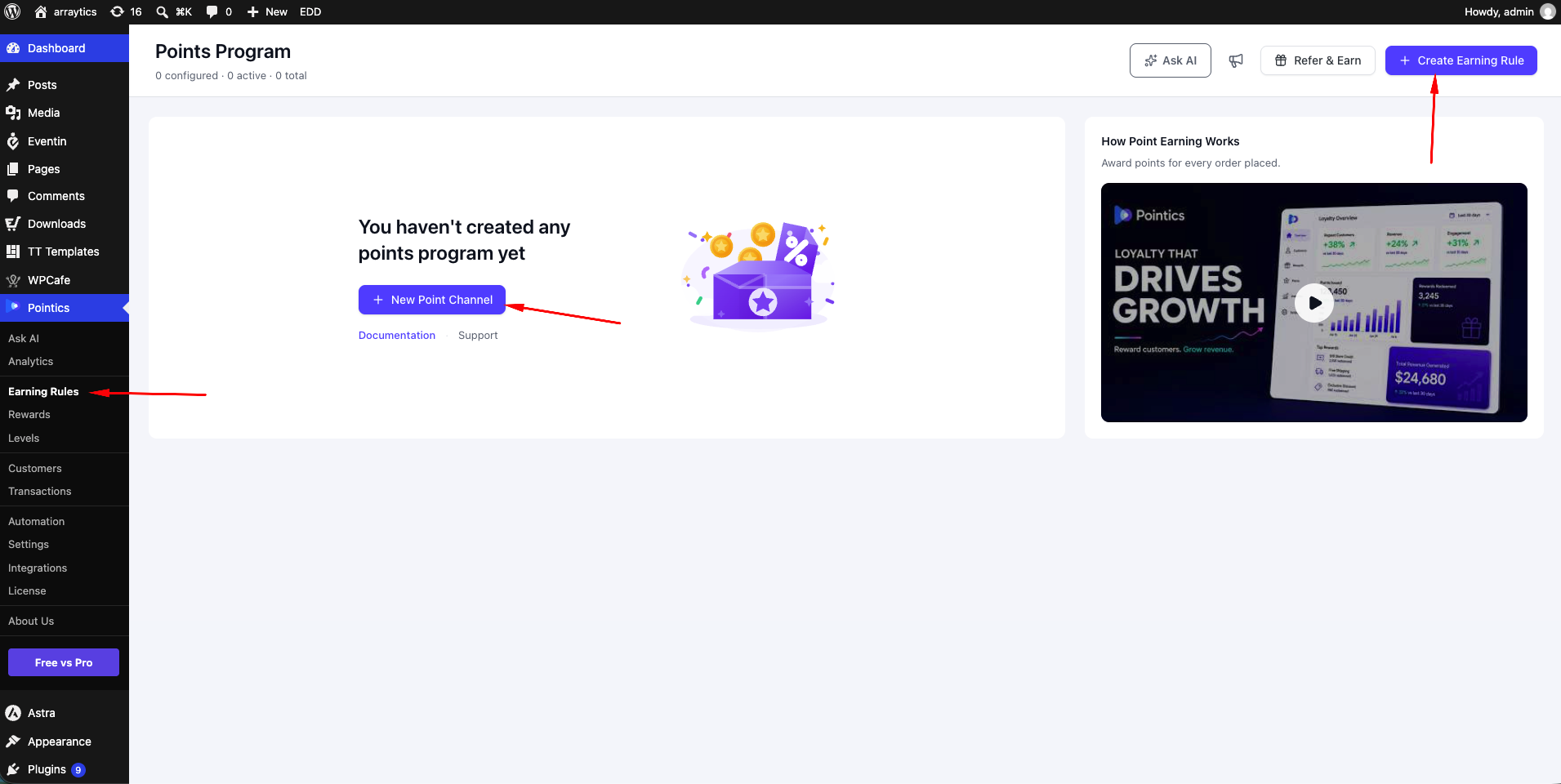
Go to Pointics → Points Program and click New Point Channel. The Add Point Earning Rule picker will open.
Step 2: Pick a Trigger #
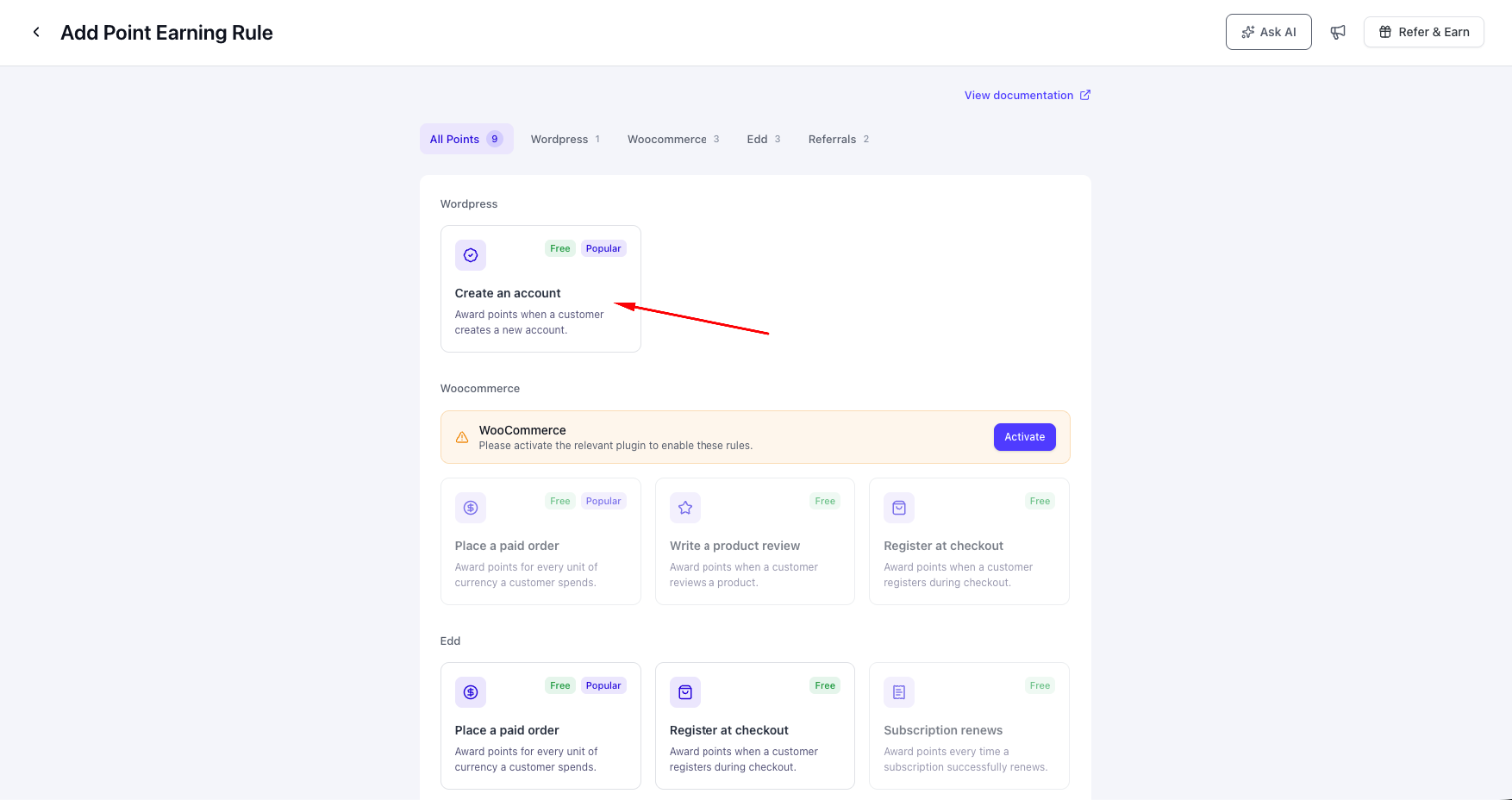
Select the store event that the rule should listen for. Recommended triggers display a badge.
| Trigger | Fires When | Money-Based? | Group | Default Points | Recommended |
|---|---|---|---|---|---|
| Place a paid order | An order is paid for | Yes | Points Earning | 1 | Yes |
| Write a product review | A customer reviews a product | No | Social | 250 | No |
| Register at checkout | A customer creates an account during checkout | No | Points Earning | 1500 | No |
| Create an account | A customer registers on the site | No | Points Earning | 1500 | Yes |
| Referral signs up | An invited friend creates an account | No | Social | 500 | Yes |
Place a paid order also reverses itself. If the order is refunded, the awarded points are removed.
Step 3: Fill In the Rule Details #
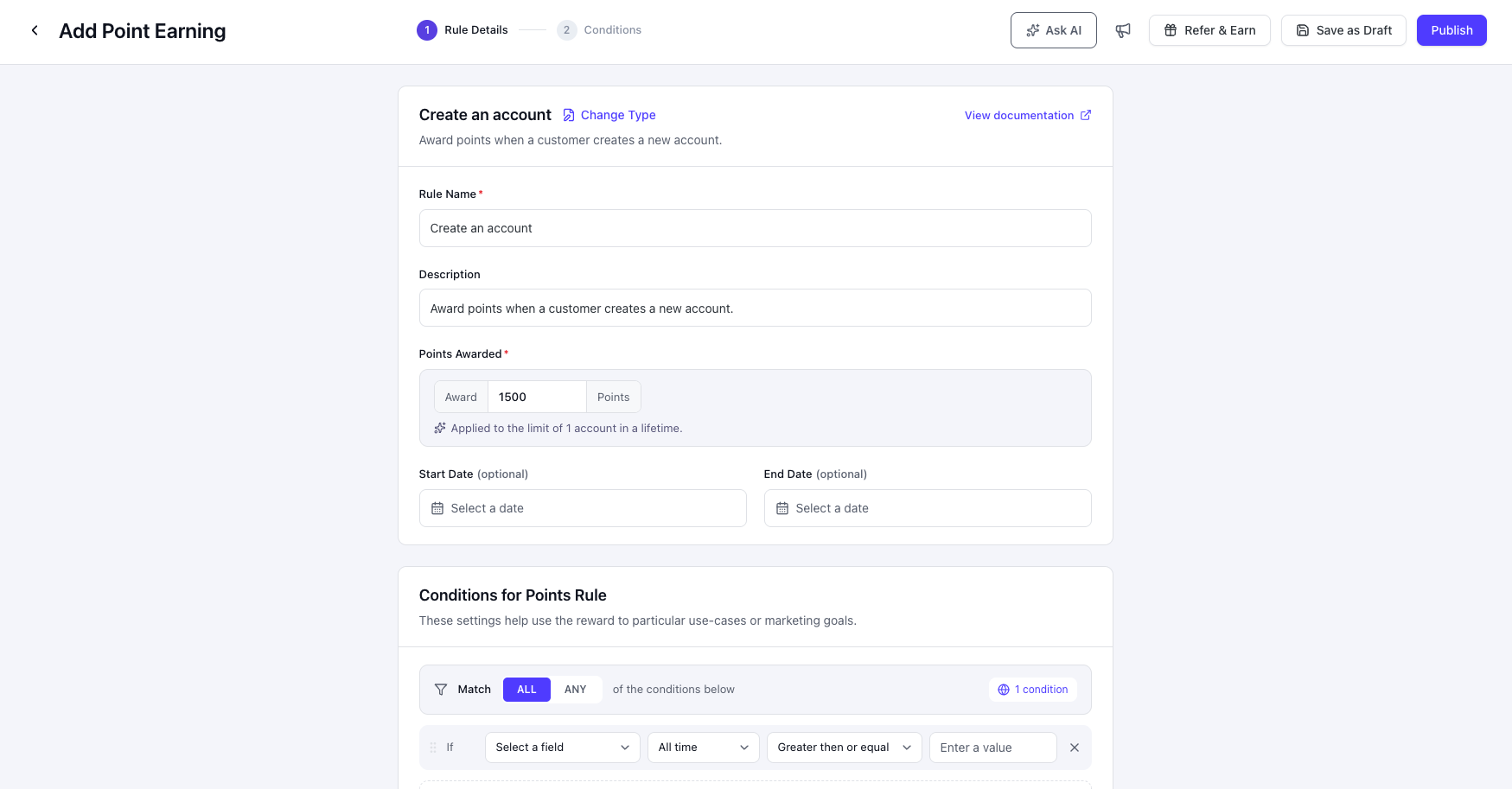
The Add Point Earning editor contains two sections in the left sidebar: Rule Details and Conditions.
| Field | Description | Default |
|---|---|---|
| Rule Name | Displayed on the rule card and in transactions | The trigger label |
| Description | Optional supporting text | The trigger description |
| Start Date | Optional beginning of the active period | Empty |
| End Date | Optional end of the active period | Empty |
Step 4: Set the Award #
The editor displays different award fields depending on the selected trigger.
Standard Award #
Used for flat, non-money-based triggers.
| Field | Description | Default |
|---|---|---|
| Points Awarded | Defines how many points the customer receives | The trigger default |
Earning Rate Award #
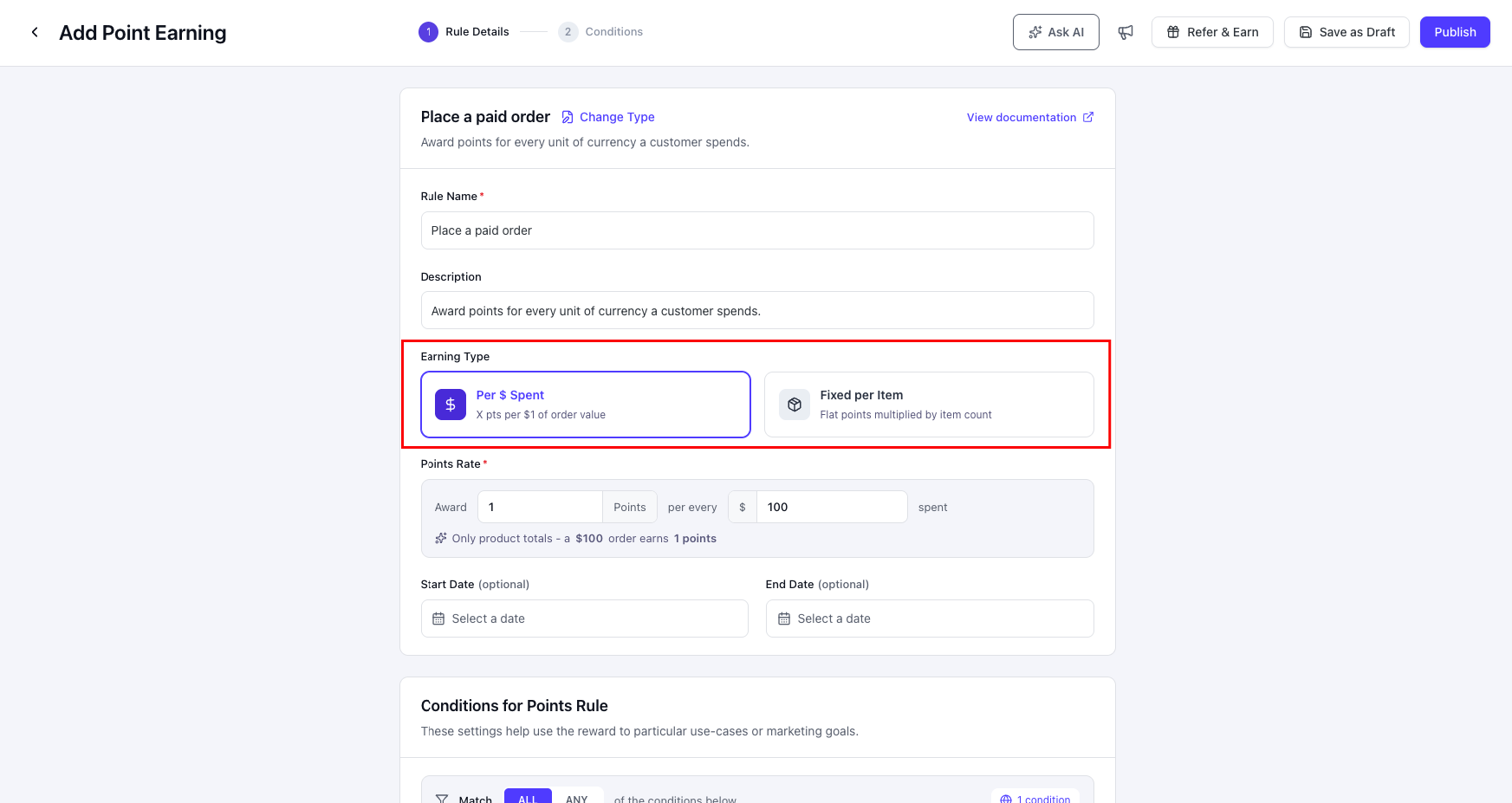
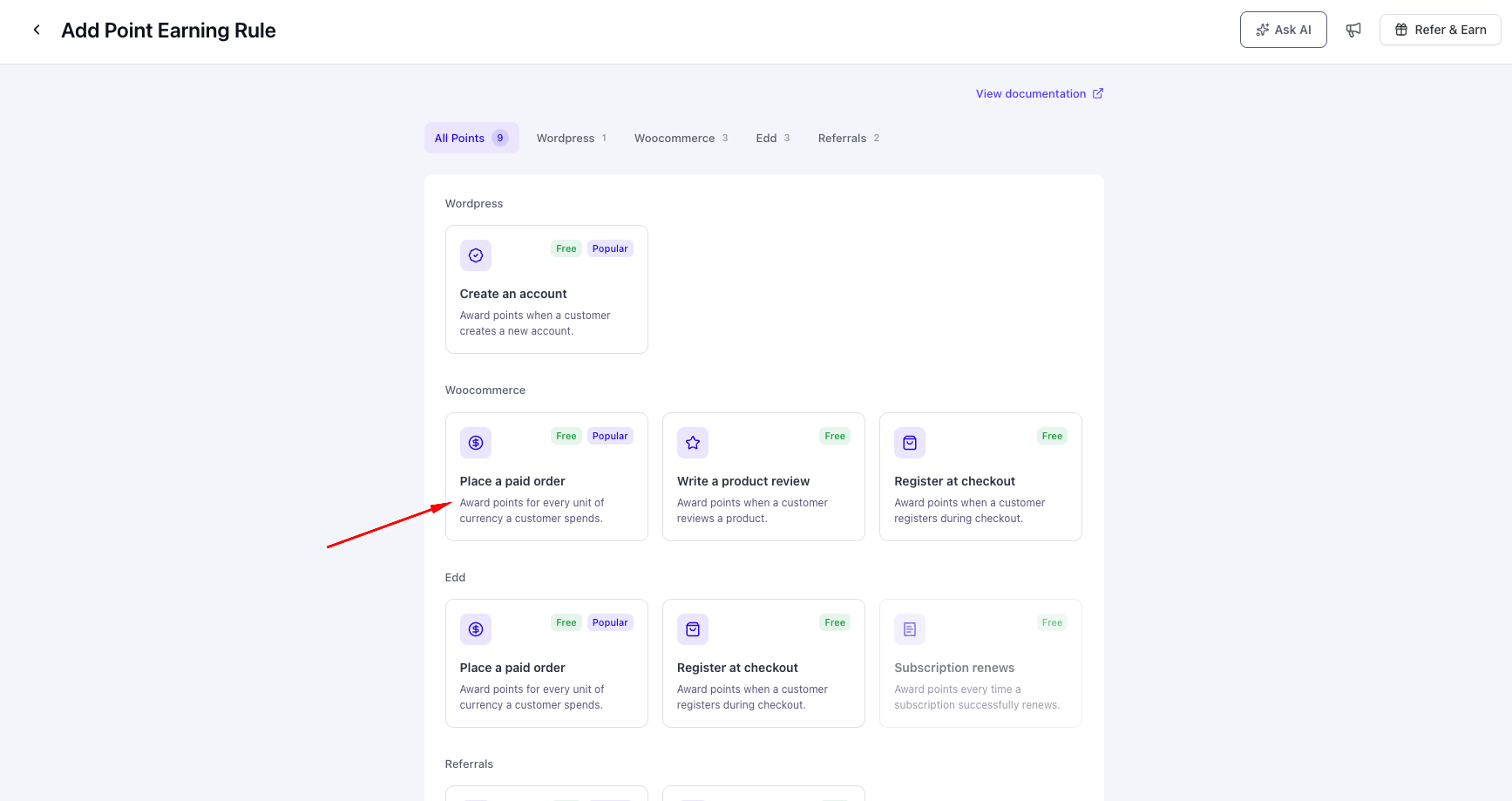
Used for money-based triggers.
| Field | Description | Default |
|---|---|---|
| Earning Type | Per $ Spent awards points for each currency unit spent. Fixed per Item awards a flat number of points multiplied by item quantity. | Per $ Spent |
| Points Rate | Defines how many points are awarded for each specified amount spent | The trigger default |
If the amount in the “per every” field is empty or set to zero, the rule awards no points. Always complete both values.
Referral Award #
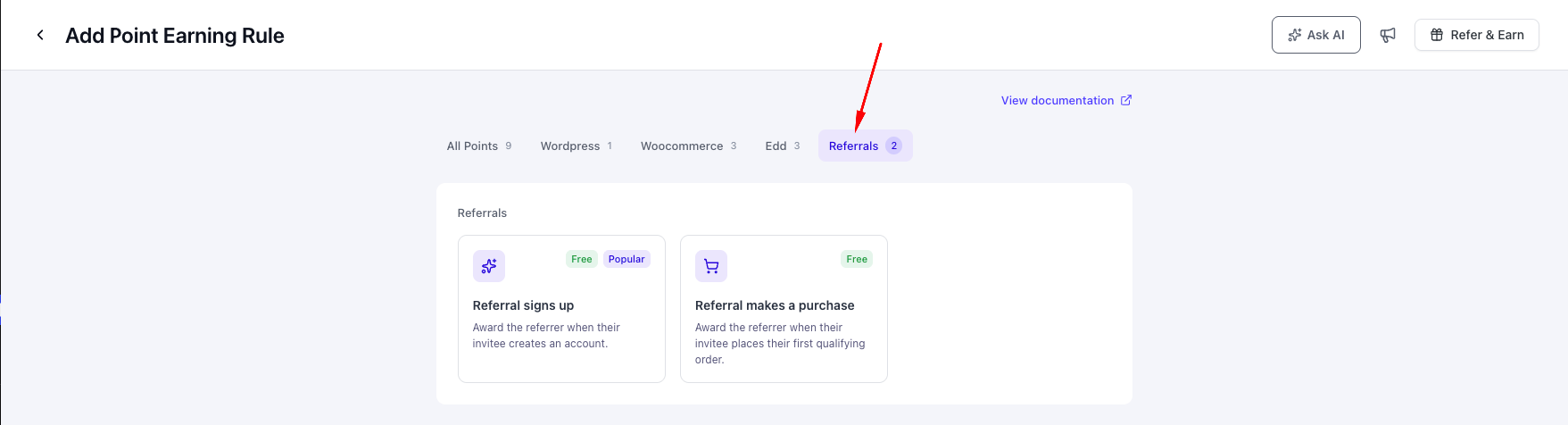
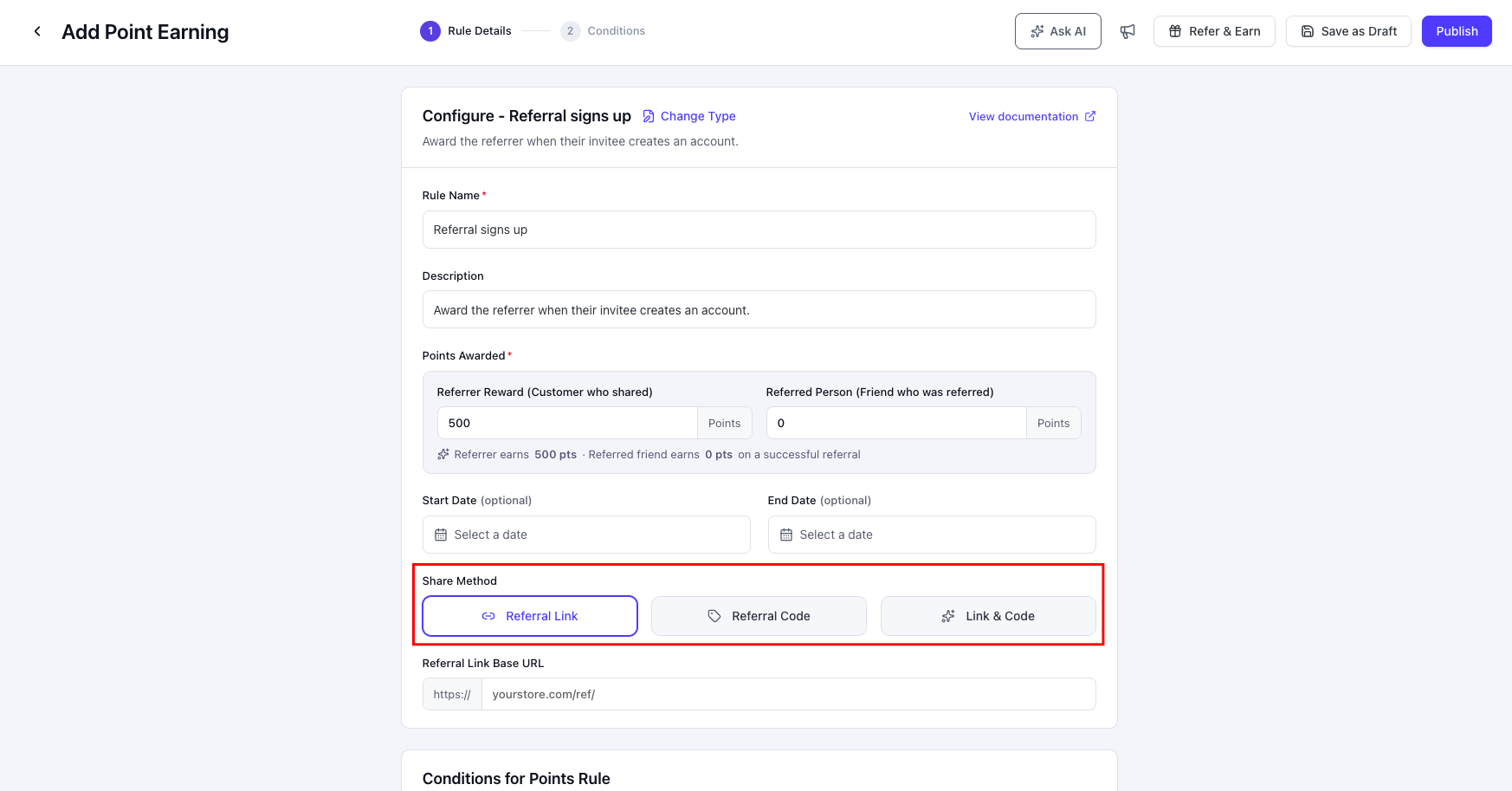
Used for referral-based triggers.
| Field | Description | Default |
|---|---|---|
| Points Awarded — Referrer | Points awarded to the customer who sent the invitation | The trigger default |
| Points Awarded — Referred Person | Points awarded to the invited customer | Empty |
| Share Method | Referral Link, Referral Code, or Link & Code | Empty |
| Referral Link Base URL | The base URL used for referral links, such as yourstore.com/ref/ | Empty |
| Referral Code | A custom referral code, such as SAVE20 | Empty |
Step 5: Add Conditions #
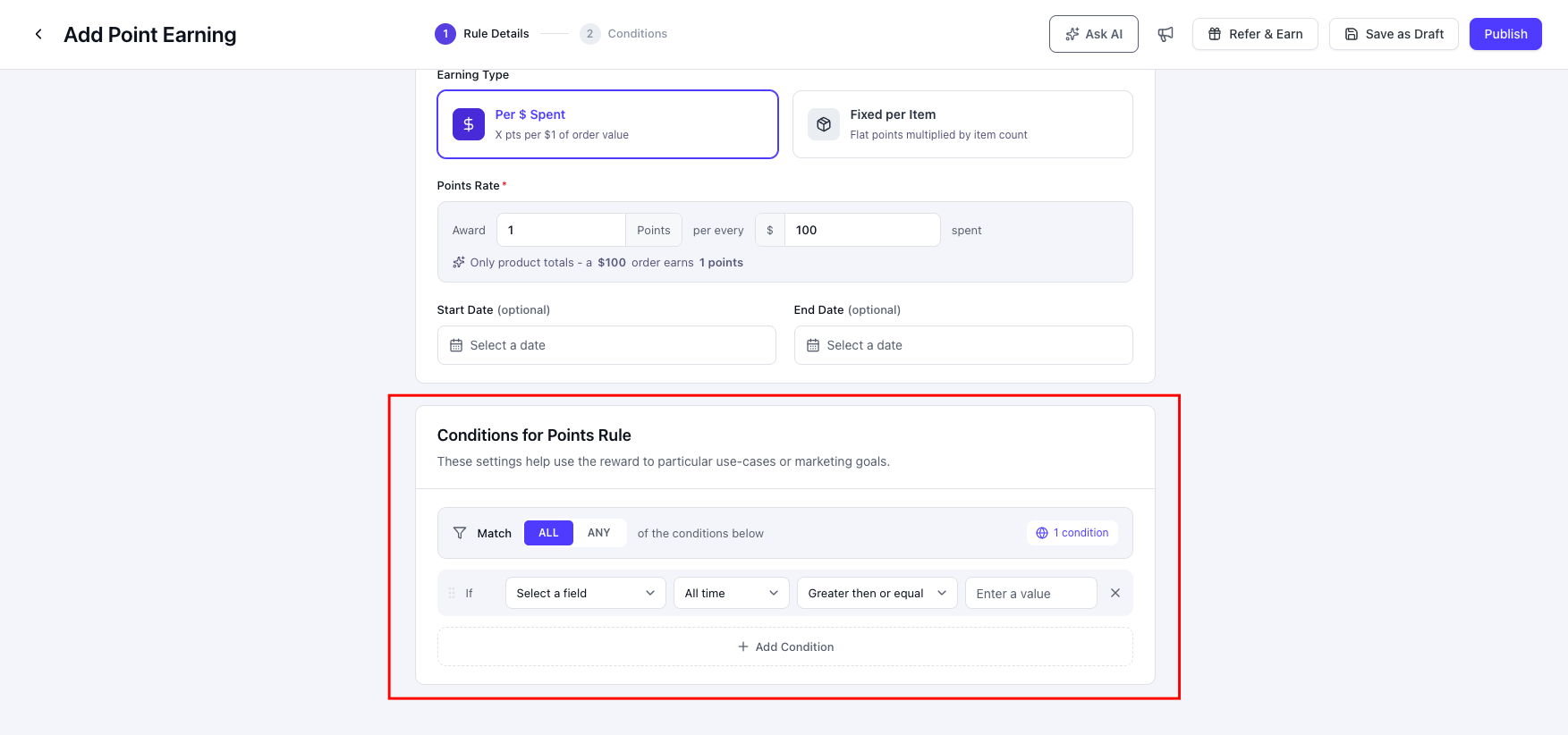
Add one or more conditions and choose whether the rule must match all conditions or match any condition.
| Condition | What It Checks |
|---|---|
| Minimum Amount | The order or event value is at least the configured amount |
| First Time Only | The customer has never activated this rule before |
| Date Window | The event happens between a specified start and end date |
| User Role | The customer has one of the selected WordPress roles |
Conditions are a Pro feature. In the free version, the conditions section remains visible but locked.
Step 6: Save the Rule #
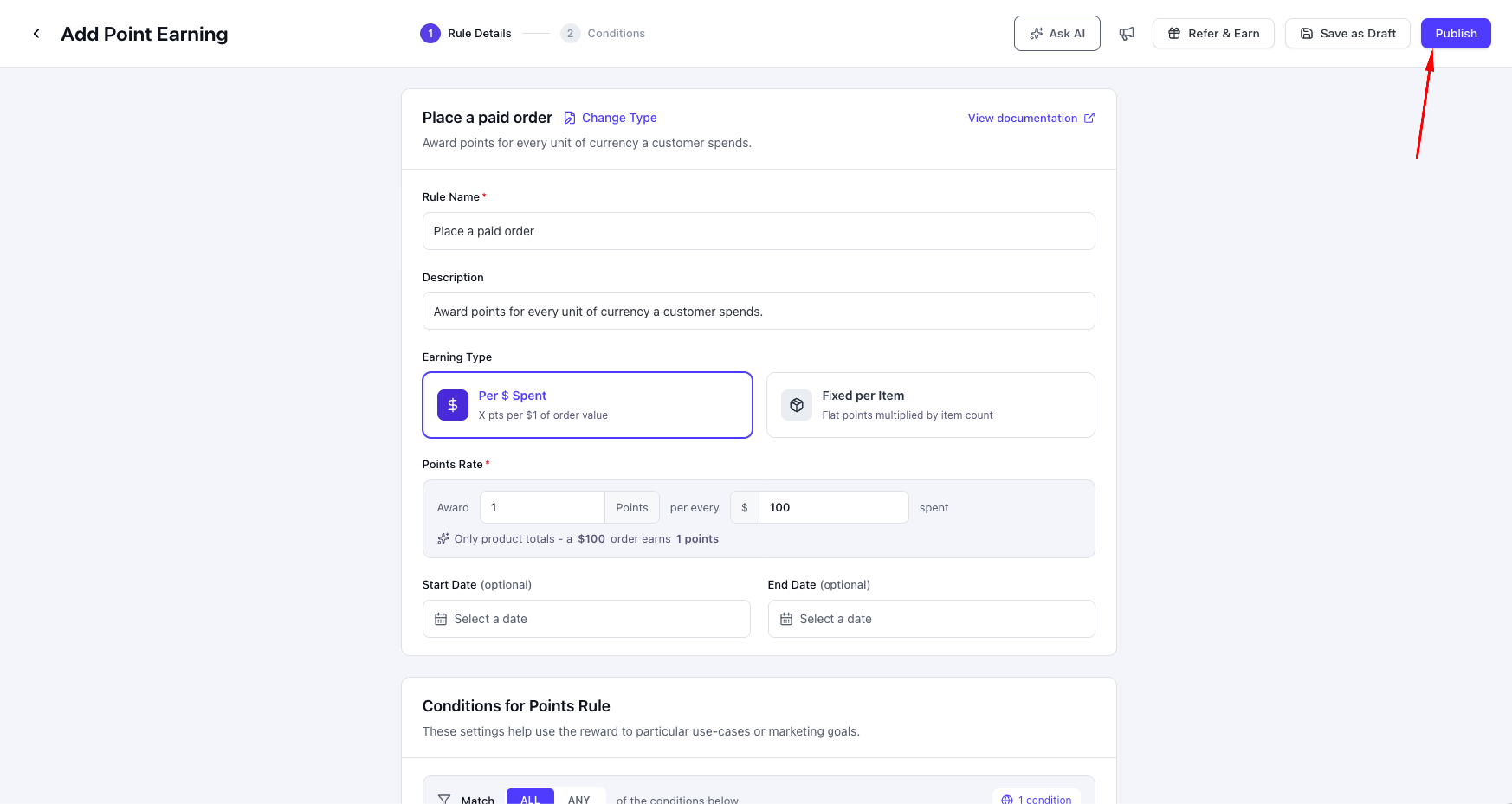
- Save Draft: Saves the rule as inactive. Only a rule name is required.
- Publish: Activates the rule. A rule name and a complete award configuration are required.
Step 7: Manage Your Rules #
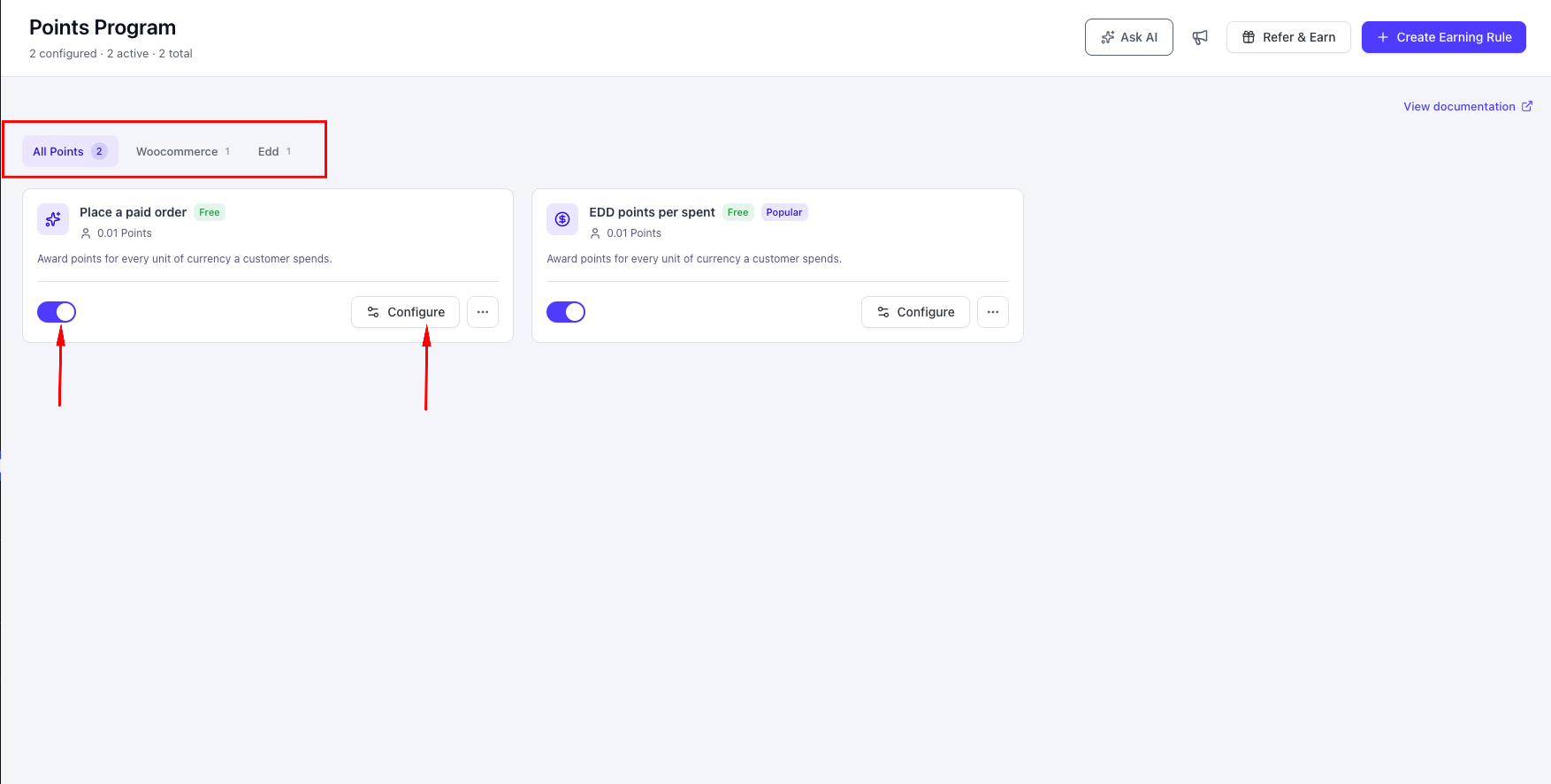
- Edit: Click Configure on a rule card. The editor title changes to Edit Point Earning. The trigger cannot be changed after saving, so create a new rule if you need a different trigger.
- Turn On or Off: Use the switch on the rule card. If saving fails, the switch returns to its previous state and an error message appears.
- Delete: Click the delete option on the rule card. Pointics asks for confirmation before deactivating it.
- Filter: Use the filter chips above the rule grid. Available groups include All Points, Points Earning, Social, and any groups added by integrations.
Delete this point channel? {name} will stop awarding points. Points customers already earned from it are kept.
Deleting a rule only deactivates it. Points that customers already earned are never removed.
Key Functionality #
Calculation Types #
| Type | What It Does |
|---|---|
| Fixed Amount | Awards a flat number of points |
| Points per Currency Unit | Awards points according to the amount spent |
| Percentage of Amount | Awards a percentage of the transaction value as points |
| Tiered | Multiplies the base points by the customer’s loyalty-level multiplier |
How Often a Rule Can Run #
| Setting | Meaning |
|---|---|
| Once | The customer can receive the award only once |
| Unlimited | The rule has no usage limit |
| Daily | The rule can award points once per calendar day |
| Weekly | The rule can award points once per week |
| Monthly | The rule can award points once per month |
| Maximum N Times Total | The rule can award points no more than the configured number of times |
| Maximum N Times per Period | The rule can award points up to the configured limit during each period |
If a frequency setting becomes invalid or corrupted, Pointics falls back to Once, the most restrictive option. This prevents a configuration error from creating unlimited point awards.
How a Rule Awards Points #
A point-earning rule follows this process from creation to customer balance update:
- Open the Points Program screen.
- Click New Point Channel.
- Select a trigger from the trigger picker.
- Configure the rule in the rule editor.
- Choose Save Draft to store the rule as inactive, or choose Publish to activate it.
- When the related store event happens, Pointics checks the rule conditions.
- If the conditions do not match, no points are awarded.
- If the conditions match, Pointics checks the frequency limit.
- If the customer has already reached the allowed limit, no points are awarded.
- If the award is allowed, Pointics calculates the points.
- A transaction is recorded and the customer balance is updated.
- The customer sees the updated balance.
- If a paid order is refunded, the points awarded by that order rule are taken back.
Validation Rules #
- Rule Name, trigger, and calculation type are required.
- The calculation type must be supported by your site. A Pro-only calculation is rejected on a free installation.
- The frequency value must be one of the supported options.
- Editing is partial: Any field you do not change remains unchanged.
- Save Draft requires a rule name.
- Publish requires a rule name and a complete award configuration.
- Both save buttons are disabled while a save is running to prevent duplicate submissions.
Every rule is assigned to a group. If you do not select one, Pointics uses the trigger’s group. If the trigger does not provide a group, Pointics uses the integration name. There is no uncategorized group.
Limitations #
- The free version displays conditions but does not allow you to configure them. The section remains visible and locked unless Pointics Pro is active.
- The Start Date, End Date, and Conditions fields are not currently saved. Only the rule name, description, award, and active state are stored.
- The uses count on each rule card always displays 0. Use the Transactions screen to view actual activity.
- Deleting a rule only deactivates it. The screen does not provide permanent deletion.
- Only the Place a paid order trigger reverses awarded points after a refund.
Troubleshooting #
| Problem | Solution |
|---|---|
| Trigger picker is empty | No integration is active. Activate WooCommerce or another supported integration. |
| “Channel not found.” | The rule was deleted, or the link you followed is no longer valid. |
| “No updatable fields provided.” | The save request contained no changed fields. Reload the editor and try again. |
| “Unknown calc_type…” | The selected calculation type is not supported by your site. This commonly happens when a Pro-only calculation is selected on a free installation. |
| “Unknown frequency…” | The frequency value is not one of the supported options. |
| “Award produced no points or was blocked.” | The conditions did not match, the frequency limit was reached, or the calculation produced zero points. |
| Rule is published but no points are awarded | Confirm that the trigger integration is active, the conditions match, the frequency limit has not been reached, and the calculation does not return zero. A blank “per every” value makes the rate zero. |
| Points were awarded, but the card says “not configured” | A rule is marked as unconfigured when its points value is zero. |
| A refund did not remove points | Only the Place a paid order trigger reverses points after a refund. |
| “No rules in this group yet.” | The selected group contains no rules. Switch the filter to All Points. |
Notes #
- The default groups included with Pointics are Points Earning and Social. Integrations can add their own groups.
- Money-based events award points according to the amount spent. Other events award a flat number of points.
- The Setup Wizard uses the same distinction when it creates earning rules.
- Point awards and customer balances are updated together, so they cannot become out of sync.
- Frequency limits are checked when the transaction is written, which protects the program from duplicate events.


