How Many Loyalty Points Should You Give Customers?


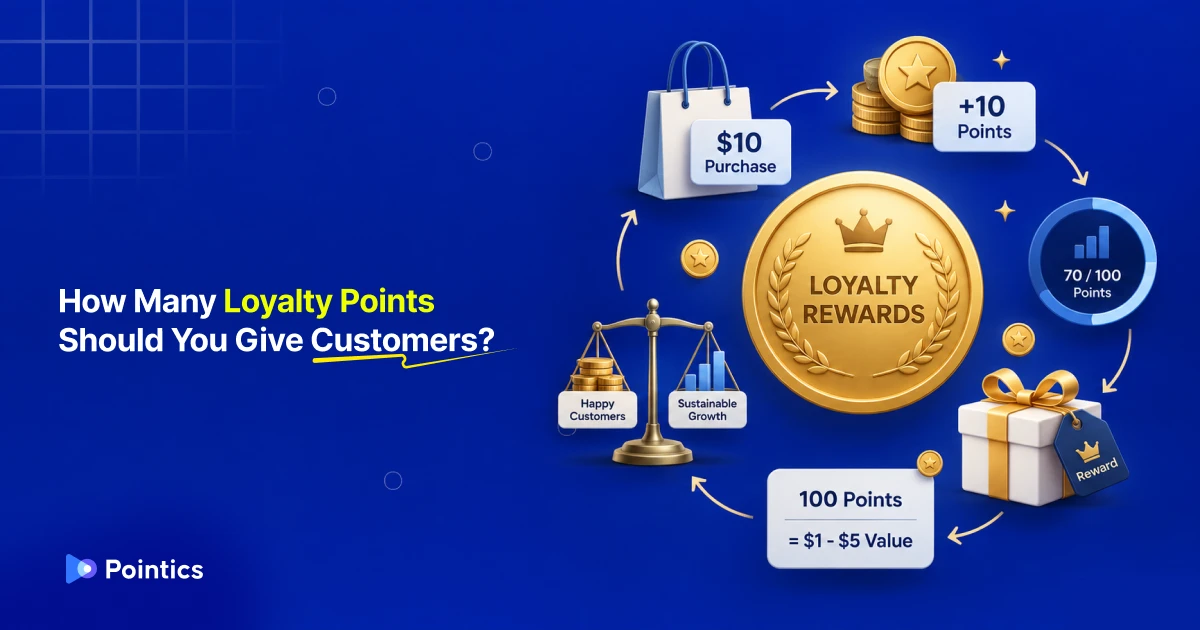
Table of Contents
A loyalty program works best when customers can quickly understand what they earn and what their points are worth. Give too many points, and your reward costs may reduce your margins. Give too few, and customers may not feel motivated to return.
So, how many loyalty points should you give customers? A practical starting point is 1 point for every $1 spent. You might then make 100 points worth between $1 and $5, depending on the reward rate your store can support. This is a starting example, not a universal rule. Your ideal loyalty points calculation depends on your margins, average order value, and customer purchase frequency.
In this guide, you will learn how many loyalty points to give customers, how to calculate loyalty points, choose a sustainable reward rate, and build a loyalty points system that gives customers a clear reason to return.
✦ Key Takeaways
- Start with a simple earning rule, such as 1 point for every $1 spent.
- Connect the earning rate with a clear redemption value so customers understand what their points are worth.
- Base your reward rate on your margins, average order value, and customer purchase frequency.
- Reward valuable actions beyond purchases, including account registration, product reviews, and referrals.
How to Calculate Loyalty Points: Formulas and Examples
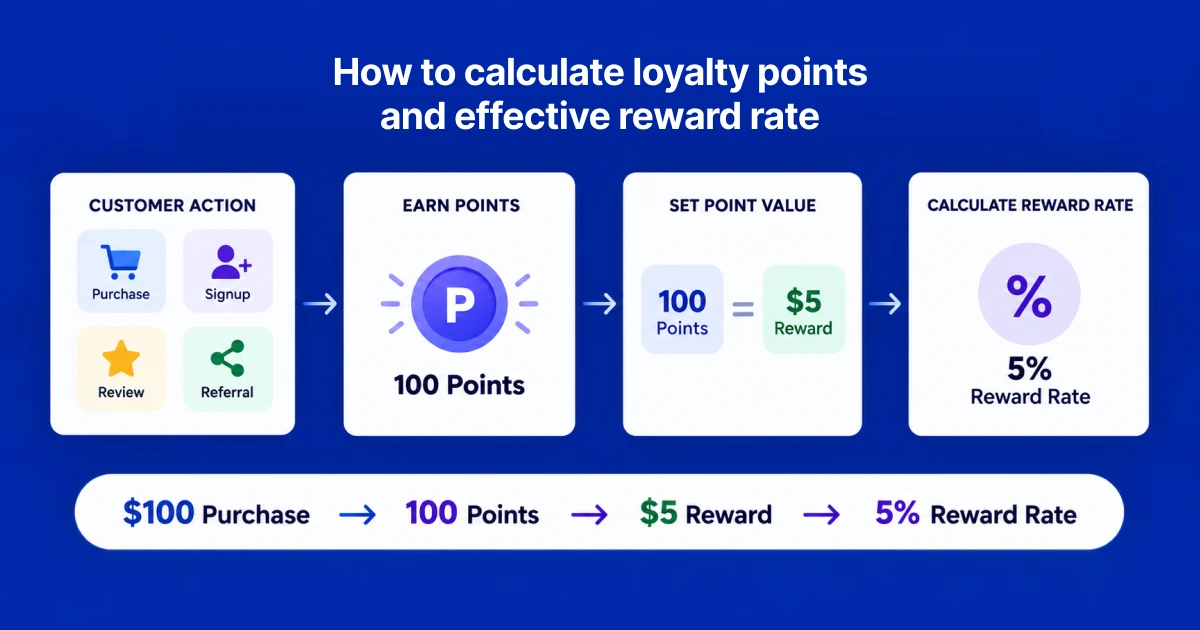
How are loyalty points calculated? Purchase points are based on eligible spending, while signup, review, referral, and other action points use configured amounts. Both earning methods should connect to a clear redemption value.
A loyalty points system can use either or both of these earning methods:
- Spending-based points: Calculated from the customer’s eligible purchase amount
- Action-based points: A configured number of points awarded for completing a specific action
This distinction is important because customers can earn points through both purchases and engagement. Other loyalty platforms also document different earning rules for purchases, account creation, reviews, referrals, and other customer actions.
Step 1: Calculate Purchase Points
Purchase points are calculated from the eligible product total and the earning rule configured by the store.
Purchase points = Eligible product total ÷ Spend per award × Points awarded
For example:
- Eligible product total: $100
- Spend per award: $1
- Points awarded: 1 point
$100 ÷ $1 × 1 point = 100 points
The customer earns 100 points from the $100 eligible purchase.
Define eligible spending clearly: whether it excludes shipping, taxes, fees, certain products, and discounts. Explain whether amounts paid with rewards earn points and how you handle decimals. For example, a $39.90 eligible order earns 39 points at 1 point per $1 if you round down to whole points.
Step 2: Calculate Points for Signups, Reviews, and Referrals
Action-based points do not depend on how much the customer spends. The store assigns a specific number of points to each eligible action.
Action points = Points configured for the completed action
For example, a loyalty points system might be configured to award:
- 100 points for creating an account
- 50 points for submitting an eligible product review
- A chosen number of points after a referral meets the required condition
If a customer completes a signup action worth 100 points, the calculation is simply:
1 completed signup × 100 configured points = 100 points
The same method applies to reviews and referrals. However, referral points should only be awarded after the required event, such as a successful signup or completed purchase, has occurred.
These amounts are examples, not universal recommendations. The points assigned to each action should reflect its value to your business.
Step 3: Calculate the Value of One Loyalty Point
To calculate the value of one loyalty point, divide the reward value by the number of points required to claim it.
Point value = Reward value ÷ Points required
For example:
- Points required: 100
- Reward value: $5 discount
$5 ÷ 100 points = $0.05 per point
Each point is worth $0.05 when 100 points provide a $5 discount.
In this fixed-value example, each point has the same redemption value, whether earned from purchases, signups, reviews, or referrals.
Step 4: Calculate the Effective Purchase Reward Rate
The effective purchase reward rate shows how much of an eligible purchase returns to the customer as future reward value.
Effective purchase reward rate = Purchase points earned × Point value ÷ Eligible product total × 100
Using the purchase example:
100 points × $0.05 ÷ $100 × 100 = 5%
The customer spends $100, earns 100 purchase points, and receives $5 in future reward value. The effective purchase reward rate is therefore 5%.
Only purchase points should be used in this calculation. Signup, review, and referral bonuses are separate incentive costs because they are not earned directly from the purchase amount.
Step 5: Calculate the Reward Value of Action-Based Points
Multiply the points awarded for an action by the value of one point.
Action reward value = Configured action points × Point value
At $0.05 per point:
- 100 signup points provide $5 in reward value.
- 50 review points provide $2.50 in reward value.
This loyalty points calculation shows the reward’s face value. Actual business cost depends on redemption and reward type. Budget action bonuses separately from purchase rewards when building a customer loyalty program in WordPress.
How Many Points Should You Give Customers?
Start with a purchase reward rate your margins can support, then work backward to choose how many points to award.
Points per $1 = Target reward rate as a decimal ÷ Point value
For a separate example, suppose your target reward rate is 2% and each point is worth $0.01:
0.02 ÷ 0.01 = 2 points per $1
A $40 eligible order earns 80 points, worth $0.80 in future rewards. Next, check whether your redemption threshold lets customers reach a useful reward within a realistic number of purchases.
How Should Average Order Value Affect Loyalty Points?
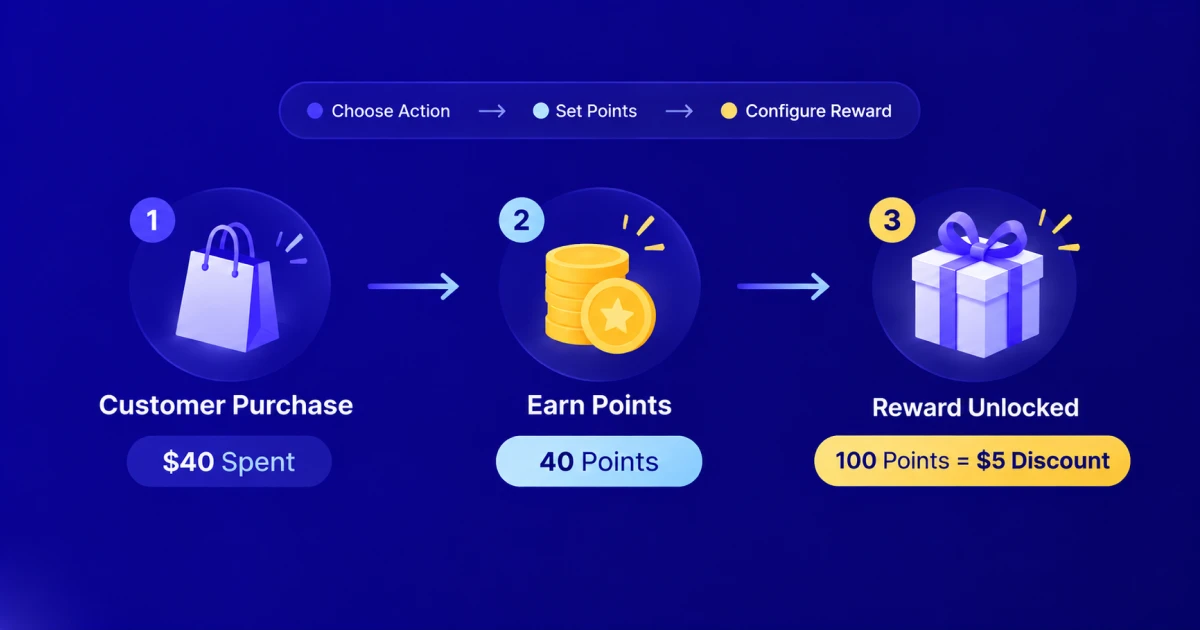
Returning to our original 1-point-per-$1 example, suppose your average eligible purchase is $40, customers earn 40 points per order, and 100 points provide a $5 reward.
Example of Earning Loyalty Points on $40 Orders:
| Purchases | Total Spending | Points Balance |
|---|---|---|
| 1 | $40 | 40 points |
| 2 | $80 | 80 points |
| 3 | $120 | 120 points |
Purchases needed = Points required ÷ Points per average order, rounded up
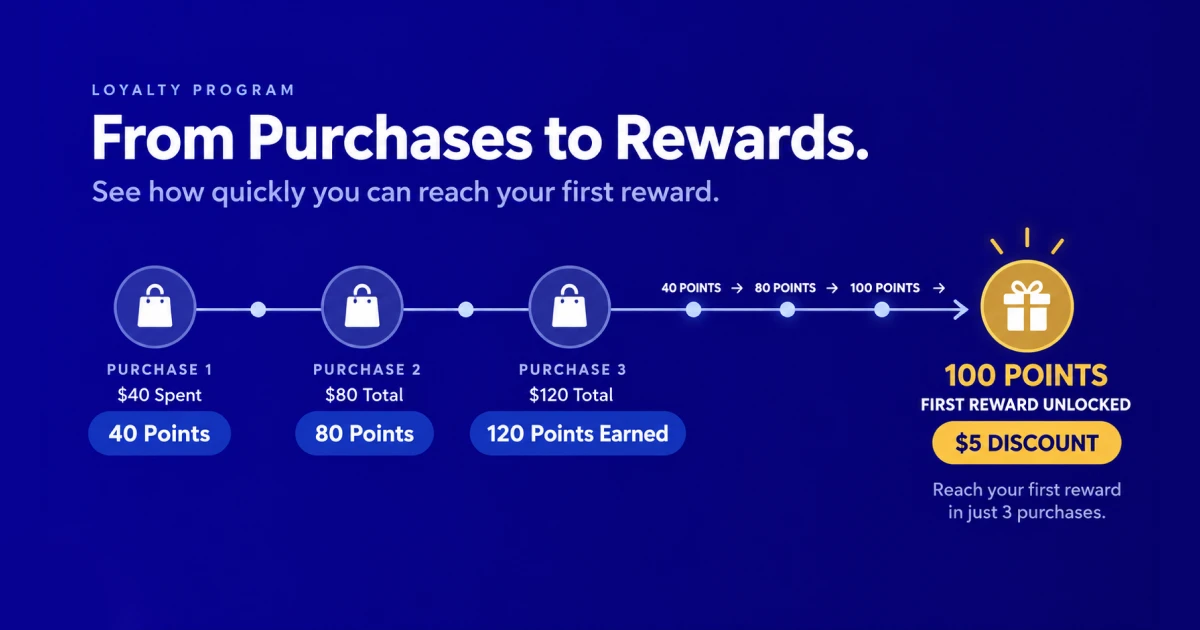
Here, 100 ÷ 40 = 2.5, so the customer reaches the threshold once points from the third purchase are credited. Assuming no starting points, bonuses, or earlier redemptions, redeeming 100 of their 120 points leaves 20. When the $5 reward becomes usable depends on your program’s rules.
A higher threshold does not always mean a lower reward rate. At 1 point per $1, both 100 points for $5 and 200 points for $10 return 5%; the second takes longer to unlock. Requiring 200 points for the same $5 lowers the rate to 2.5%.
Set Action-Based Rewards Separately
Set eligibility conditions and frequency limits for signup, review, and referral bonuses. Keep their combined reward value within your incentive budget. Explore these loyalty program ideas for purchases and customer engagement for more examples.
How Do Unredeemed Points Affect Reward Costs?
Some issued points are never redeemed; this is called breakage. Avoid assuming a fixed breakage rate when setting your rewards. Use your own redemption data as it becomes available.
If a program issues $5 in reward value and customers redeem 80%, the expected redeemed value is:
$5 × 80% = $4
Use this only for planning. Budget as if more customers may redeem, then use your own redemption data once the program has been running.
Apply Your Loyalty Points Strategy with Pointics
Once your calculations work on paper, use Pointics to put your earning rules and rewards into practice.
Connect Earning and Redemption Rules
For the $40-order example, your intended setup is 1 point per $1 of eligible spending and a $5 reward for 100 points. Keep signup, review, and referral bonuses within a separate budget.
A clear WooCommerce loyalty points system should explain eligible purchases, when points become available, and how customers redeem them. Check your settings, then test a purchase, a redemption, and a refund before launch.
Review Results and Adjust
Track earned and redeemed points, time to first reward, repeat purchase rate, and average order value. Compare redeemed reward value with eligible sales to monitor affordability.
If customers earn points but rarely redeem them, check whether rewards are clear and achievable. Consider seasonal changes and promotions when reviewing results. Apply earning-rate changes to future activity and communicate clearly without unexpectedly reducing existing balances.
If you are still choosing a plugin, compare Pointics with WPLoyalty, myCred, and LoyaltyX against the rules and rewards you need.
Common Loyalty Points Calculation Mistakes
The most common loyalty points calculation mistakes happen when businesses ignore point value, reward cost, and redemption difficulty.
Setting Points Without a Clear Value
Giving 1, 5, or 10 points per dollar means little unless customers know what those points are worth. Connect each earning rule to a clear redemption value.
Making Rewards Difficult to Reach
Customers may lose interest if the first reward requires too many purchases. Compare your average order value with the redemption threshold to keep rewards achievable and affordable.
Using an Unclear Expiration Policy
Choose an expiration period that gives customers a realistic chance to earn and redeem rewards within their usual purchase cycle. Explain when points expire and how customers will be notified. Review how points expiry works in Pointics before setting your policy. Expiry configuration may require developer or support assistance when the options are unavailable in your Settings screen.
Ignoring Refunds and Cancellations
Points from refunded or cancelled orders may need to be revoked to keep customer balances accurate. Pointics’ “Place a paid order” trigger awards purchase points and reverses them when the order is refunded. See how to manage point-earning rules.
Frequently Asked Questions
What Is a Good Loyalty Reward Percentage?
A 1% to 5% reward rate can be used as a starting model. Choose the final percentage based on your profit margin, average order value, and repeat-purchase frequency.
How Many Loyalty Points Should Equal $1?
Divide the points required by the reward value. If 100 points provide a $5 reward, then 20 points equal $1.
How Do You Set Loyalty Points Without Hurting Profit Margins?
Suppose a $40 order leaves $12 after product and other variable costs. If you need $10 toward overhead and profit, up to $2 remains for rewards and program costs. A 5% purchase reward uses that entire $2 if fully redeemed, leaving no room for extra bonuses or fees. Choose a lower rate if those also need funding.
How Quickly Should Customers Reach Their First Reward?
Customers should reach the first reward within a realistic purchase cycle. Compare the redemption threshold with the points generated by an average order.
Should Loyalty Points Be Based on Revenue or Profit?
Purchase points can be calculated from eligible revenue, but the earning rate and reward value should be limited by the profit available after variable costs.
Create a Loyalty Points System Customers Understand
A successful loyalty points system clearly connects how customers earn points, what those points are worth, and when they can redeem them.
Pointics helps businesses reward purchases, registrations, reviews, and referrals and manage rewards and loyalty activity. Start with one simple earning rule and one achievable reward, then improve the program using actual customer behavior.
Explore Pointics pricing and plans when you are ready to choose the right option for your store.