How to Build a Customer Loyalty Program in WordPress: Step-by-Step


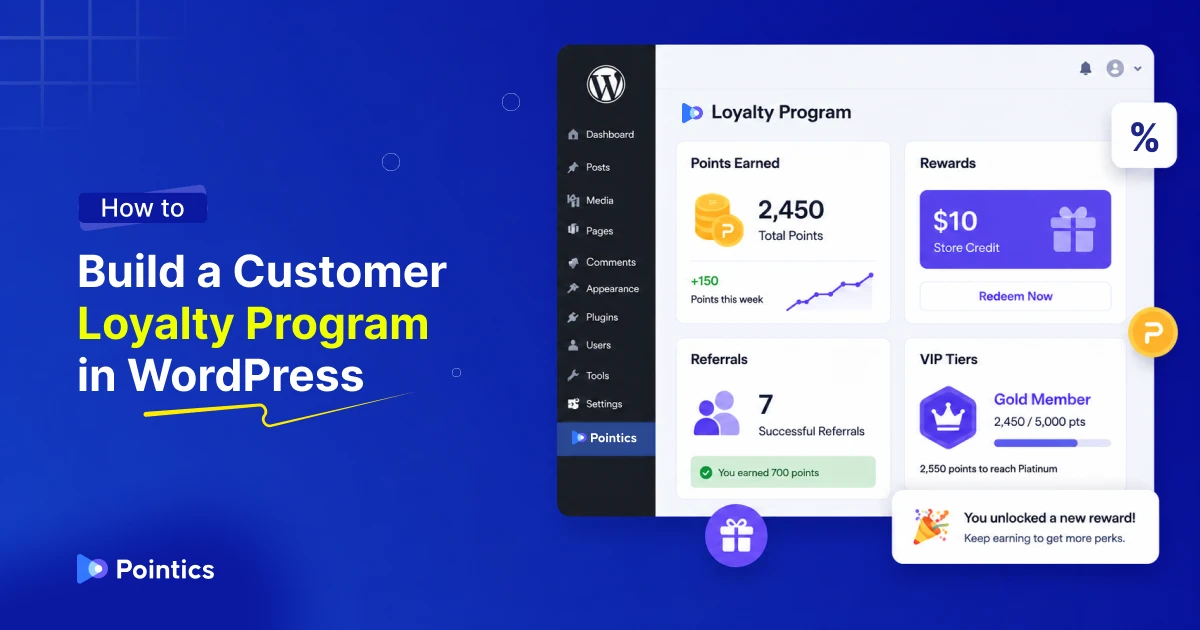
Table of Contents
A customer loyalty program in WordPress helps businesses reward customers for purchases, reviews, referrals, and repeat engagement. Customers can earn points, discounts, perks, or VIP benefits that give them a reason to return.
To build an effective program, you need to decide which actions to reward, set clear point values, create useful rewards, and define redemption rules.
This guide explains how to build a customer loyalty program WordPress users can easily understand and how Pointics can simplify the setup.
- A WordPress loyalty program rewards purchases, referrals, reviews, bookings, and other valuable customer actions.
- Start with a clear goal, simple earning rules, achievable rewards, and a sustainable redemption rate.
- Pointics lets you build the program manually or generate an editable starting structure with AI.
- Calculate earning and redemption values together so rewards do not hurt your margins.
- Start simple, measure customer participation and redemption, then improve the program using real behavior.
What Is a Customer Loyalty Program?
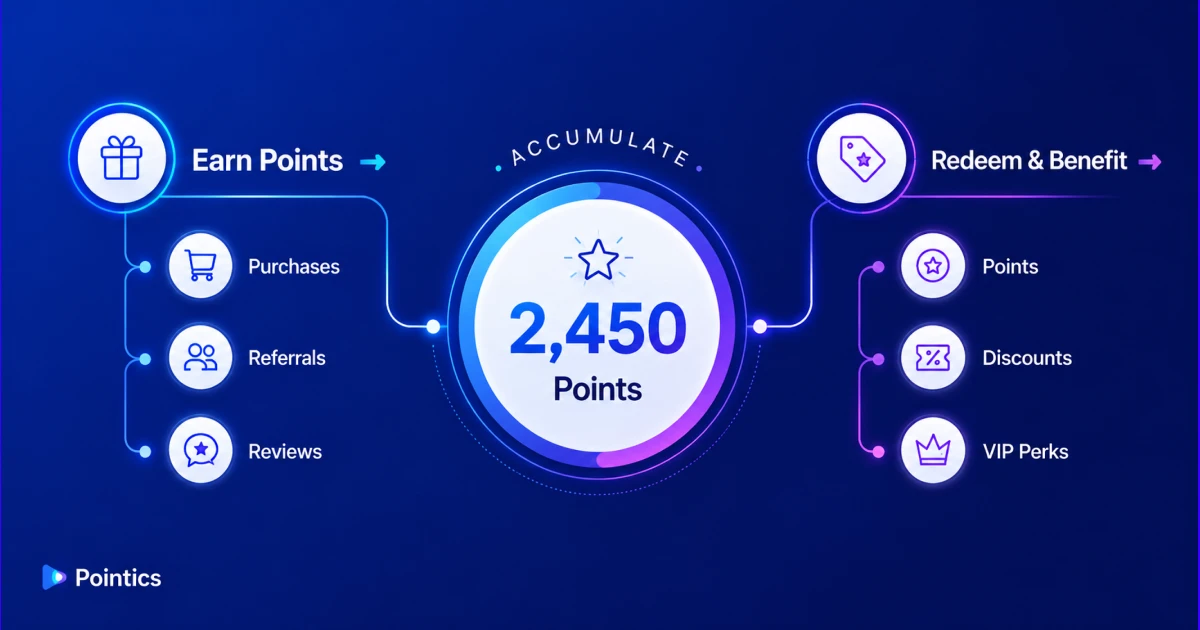
A customer loyalty program is a system that rewards customers for valuable actions such as purchases, referrals, reviews, or repeat engagement.
Customers typically earn points, discounts, perks, or status benefits that encourage them to return and interact with the business again.
Unlike a one-time discount, a loyalty program is designed to encourage an ongoing relationship with customers. The basic cycle is:
customer action → reward → repeat engagement → higher customer value
A good loyalty program makes earning and redeeming rewards simple while giving customers a clear reason to keep coming back.
How to Create a Customer Loyalty Program in WordPress Using Pointics
To create a customer loyalty program in WordPress, you need a system that can automatically track customer actions, award points, manage rewards, and update loyalty levels.
A loyalty plugin handles these tasks inside WordPress. Pointics lets you build and manage a loyalty program with earning rules, rewards, referrals, customer levels, and AI-assisted setup from your WordPress dashboard.
You can set up the program in two ways:
- Manual setup: Configure earning rules, rewards, and levels yourself.
- AI-assisted setup: Describe your business goals and let Pointics generate a starting loyalty structure that you can review and customize.
Both methods create the same core loyalty system, but they offer different ways to get started.
Option 1: Manual Setup
Manual setup is best when you already know which customer actions to reward and what those rewards should be. Pointics’ Onboarding Myself option lets you configure earning rules, rewards, levels, and branding step by step.
Step 1: Start the Pointics Setup Wizard
After activating Pointics, open the setup wizard and choose Onboarding Myself. The manual setup introduces the three main parts of the loyalty program: points earning, rewards, and customer levels. If WooCommerce or another supported integration is active, Pointics can use its available actions as triggers for your earning rules.
Step 2: Set How Customers Earn Points
Next, choose the actions customers should be rewarded for and assign a point value to each one. Pointics calls these earning rules Point Channels, with each channel connecting a customer action to a points calculation.
Start with only the actions most closely connected to your goal. For example, prioritize purchases when repeat revenue matters most or referrals when acquisition is the priority.
Step 3: Create Your First Reward
After deciding how customers earn points, create a reward they can unlock. Define the reward name, required points, and reward value, then make the reward available to customers.
Before publishing it, check the effective reward rate to make sure the redemption value remains sustainable for the business.
Step 4: Configure a Customer Level
You can then configure a loyalty level to recognize customers as they earn qualifying points. Pointics Free supports one level, while Pointics Pro supports additional levels and benefits, making it possible to build a broader VIP structure.
Customer levels use qualifying points rather than the customer’s current spendable balance, so redeeming points does not automatically reduce their loyalty status.
For a simple starting program, you might begin with one basic level and add Silver, Gold, or other VIP levels later. The purpose is to give repeat customers something meaningful to progress toward rather than adding tiers only for appearance.
Step 5: Customize the Loyalty Widget
The final manual setup step is configuring how customers see the program. Pointics lets you set the widget name, icon, colors, display style, and left or right placement. This customer-facing widget gives members a visible entry point into the loyalty experience.
Once the branding is saved, review the program as a customer. Check that earning rules are understandable, rewards are achievable, and the loyalty experience is easy to find before promoting it publicly.
Learn more: How Do I Set Up My Loyalty Program with the Pointics Setup Wizard?
Option 2: AI-Assisted Setup with Pointics
AI-assisted setup is useful when you know what you want the loyalty program to achieve but are unsure how to structure the earning rules, rewards, and levels. Describe your business and goal in plain language, and Pointics generates a starting structure that you can review before applying it.
Step 1: Choose the AI Assistant
Open the Pointics setup wizard and select AI Assistant instead of manual onboarding. Pointics uses the business information and instructions you provide to prepare an initial loyalty program structure.
This option is especially useful if you want a WordPress loyalty program without coding and do not know where to start with point values or rewards. You still remain in control because the proposed program must be reviewed before it is saved.
Step 2: Describe What You Want to Reward
Tell Pointics what kind of loyalty program you want in normal language. You can describe your business, the customer behavior you want to encourage, or specific earning rules you already have in mind.
For example:
“Give customers 10 points for every $1 they spend and 500 points for referring a friend.”
You could also give a broader instruction such as, “I run a WooCommerce coffee store. Help me reward repeat purchases and customer referrals.” The clearer the business goal is, the easier it becomes to evaluate whether the suggested structure actually supports that goal.
Step 3: Let Pointics Generate the Loyalty Structure
Pointics analyzes your request and generates a proposed structure for earning rules, rewards, and customer levels. The suggestions remain editable, so you can treat them as a starting point rather than an automatic business decision.
Step 4: Review the Suggested Rules and Rewards
Before approving the program, review each suggested earning amount, reward cost, and level threshold. Pointics allows you to rename items, change point values, remove suggested items, or ask the assistant to regenerate the plan.
Pay particular attention to the financial side of the program. If AI suggests a generous earning rate, calculate what those points will be worth when customers redeem them and adjust the values if necessary.
Step 5: Approve and Launch the Program
Once the proposed structure matches your goals, approve the plan so Pointics can apply the selected setup to your site. The important advantage is that you do not have to accept the first suggestion; you can review and adjust the program before anything is written.
After approval, test the program with a sample customer journey. Earn points, check the balance, try a reward redemption, and confirm that the customer-facing experience is clear.
Whether you choose manual or AI-assisted setup, the goal is the same: create a loyalty program that is easy for customers to understand and financially sustainable for your business.
Manual vs AI-Assisted Setup: Which Should You Choose?
| Setup Method | Best For | Main Advantage | Control |
|---|---|---|---|
| Manual Setup | Businesses that already know their loyalty structure | Full step-by-step configuration | Highest |
| AI-Assisted Setup | Businesses unsure where to start | Generates an editable starting structure | High after review |
Choose manual setup if you already know your point and reward structure. Choose AI-assisted setup if you want Pointics to generate a starting framework that you can review and adjust.
How to Design Your Loyalty Program
To design a successful loyalty program, first define the business goal, choose the actions customers should be rewarded for, set sustainable point values, create meaningful rewards, and then decide whether VIP tiers or point expiration are necessary.
A clear structure helps customers understand the program while protecting your margins.
1. Define the Main Goal
Start by deciding what you want the loyalty program to improve. Your goal might be to increase repeat purchases, generate more reviews, attract referrals, improve customer retention, or encourage higher-value orders. Keeping one or two main goals makes it easier to decide which actions deserve rewards.
For example, if your goal is repeat purchases, purchase-based points should be the core of the program. If customer acquisition is more important, referral rewards may deserve a larger incentive.
2. Choose the Earning Actions
Next, decide which customer actions should earn points. Start with a small number of meaningful actions instead of creating too many rules at once. Purchases, referrals, reviews, and account registration are usually easier for customers to understand and track.
Each earning action should connect to a measurable business result. A useful rule is simple: reward behaviors you want customers to repeat, not actions that add little value to the business.
3. Set Clear Point Value
Point values should be simple enough for customers to understand without doing complicated calculations.
Point values should be simple enough for customers to understand without complicated calculations. Assign larger rewards to higher-value behaviors, such as successful referrals, and smaller rewards to lower-effort actions such as registrations or reviews.
More importantly, calculate what those points will cost when customers redeem them. Earning rates and redemption values should always be planned together.
4. Create Rewards Customers Actually Want
Rewards need to feel valuable enough to motivate customers to participate. Common options include fixed discounts, percentage discounts, free shipping, free products, coupons, or exclusive benefits. The best reward depends on what your customers value and what your business can afford to provide.
Try to make the first useful reward achievable within a reasonable amount of activity. If customers feel that reaching a reward will take too long, they are less likely to stay engaged with the program. Ideally, customers should be able to understand how close they are to their first meaningful reward.
5. Add VIP Tiers When They Add Value
Add VIP tiers when you have enough repeat customers to make the difference between levels meaningful. You might create levels such as Bronze, Silver, Gold, and Platinum, with each level offering stronger rewards, exclusive perks, or faster point earning. This gives customers a visible reason to keep purchasing and progressing.
However, VIP tiers should not be added just to make the program look advanced. Use them when they genuinely help recognize higher-value customers and create a meaningful difference between loyalty levels.
6. Decide Whether Points Should Expire
Loyalty points do not always need to expire. Expiration can encourage customers to redeem rewards sooner, but overly short expiration periods can make a program feel restrictive. If points expire too quickly, customers may feel that the program is unfair or difficult to use.
If points never expire, the program becomes simpler for customers but may leave a large amount of unused reward value outstanding.
The best approach depends on your business model and purchase frequency. Whatever rule you choose, make the expiration policy clear before customers begin earning points.
Why Create a Loyalty Program in WordPress?
A loyalty program can help turn occasional customers into repeat customers by giving them an additional reason to return. Instead of relying only on discounts, businesses can reward behaviors that contribute to long-term growth.
Customer loyalty remains a significant business investment PwC reports that more than 60% of executives increased their loyalty budgets during their most recent planning cycle, showing how strongly businesses continue to prioritize retention and repeat engagement.
For example, a WooCommerce store might reward purchases and referrals, while a booking business could give points for completed appointments. An event website could reward repeat registrations or attendance.
The most useful benefits depend on your business goals, but a loyalty program can help you:
- Encourage repeat purchases and bookings
- Increase customer engagement between purchases
- Generate more referrals
- Encourage customers to leave reviews
- Recognize high-value customers through VIP levels
- Give customers an incentive to choose your business again
The key is to connect every reward to a behavior that creates value for your business. A loyalty program should not reward customers simply because an action is easy to track; it should encourage actions you actually want them to repeat.
What Should You Reward in a Customer Loyalty Program?
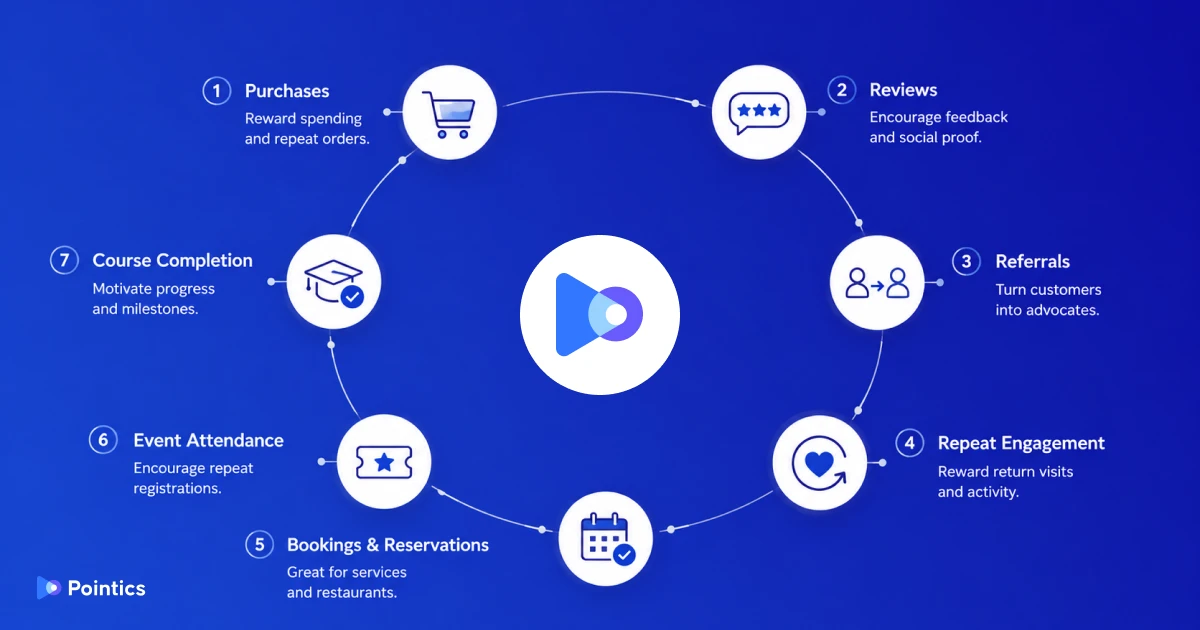
The best actions to reward in a loyalty program are purchases, referrals, reviews, repeat engagement, bookings, event attendance, and learning milestones. Choose actions that directly support your business goals rather than rewarding every possible customer activity.
Focus on behaviors that encourage customers to buy again, remain engaged, or bring new customers to your business.
Purchases
Purchases are the most common loyalty action because they directly connect rewards with revenue. You can offer a fixed number of points per order or let customers earn based on how much they spend.
For example, a store can award points based on how much a customer spends on each order.
Reviews
Rewarding reviews can help increase post-purchase engagement and generate useful social proof. A customer might earn 100 points after submitting a verified product review. Keep the incentive meaningful but modest so customers are encouraged to participate without making the review feel primarily reward-driven.
Referrals
Referral rewards can turn existing customers into an acquisition channel. You can reward the referrer when a friend signs up or completes a qualifying purchase, and you can also give the new customer an incentive.
For example, the referrer could earn bonus points after the referred customer completes a qualifying purchase, while the new customer receives a first-order incentive.
Repeat Visits and Engagement
Not every loyalty action needs to be tied directly to a purchase. You may also reward account registrations, repeat visits, logins, profile completion, or other engagement actions when they support your retention strategy. These smaller rewards can help keep customers connected between purchases.
Bookings and Reservations
Service businesses can reward customers for completed bookings or repeat reservations. This works well for salons, consultants, restaurants, fitness businesses, and appointment-based services. A booking-based reward can encourage customers to return instead of choosing a competitor for their next appointment.
Event Attendance
Event businesses can use loyalty rewards to encourage repeat registrations or attendance.
For example, customers might earn points after attending a workshop, conference, or community event. This can be especially useful for organizers who run recurring events and want to build a returning audience. Loyalty incentives can also complement other strategies used to increase event ticket sales.
Course Completion
Learning websites can reward progress such as completing a course, lesson, or milestone. These rewards can help motivate learners while giving them an extra reason to continue engaging with the platform.
For a WordPress rewards program, the best earning actions are the ones that connect customer activity with a clear business outcome.
Loyalty Program Examples for Different WordPress Businesses
A loyalty program does not have to work the same way for every WordPress website. The right structure depends on what customers do on your site and which actions create the most value for your business. An online store may focus on purchases and referrals, while a restaurant may use a restaurant loyalty program to reward repeat orders and reservations.
Here are practical examples of how different WordPress businesses can structure their loyalty programs.
| Business Type | Best Actions to Reward | Example Reward |
|---|---|---|
| WooCommerce store | Purchases, reviews, referrals | Discount, coupon, free shipping |
| Restaurant | Orders, repeat visits, reservations | Free item, discount, bonus points |
| Event website | Registration, attendance, repeat participation | Ticket discount, upgrade, early access |
| Booking business | Completed appointments, repeat bookings | Service discount, priority booking |
| LMS website | Course completion, milestones, engagement | Coupon, bonus content, member perk |
| Digital product store | Purchases, upgrades, referrals | Discount, credit, upgrade offer |
How Much Should Loyalty Points Be Worth?
A loyalty point should have a simple and predictable monetary value that your profit margins can support. For example, if 500 points can be redeemed for a $5 discount, each point is worth $0.01.
A simple formula makes this easier:
Loyalty point value = Reward value ÷ Points required
So, if a customer needs 500 points to receive $5 off:
$5 ÷ 500 points = $0.01 per point
However, point value alone does not tell you whether your loyalty program is too generous. You also need to calculate how quickly customers earn those points.
If customers earn 10 points for every $1 spent, they would earn 1,000 points after spending $100. If 1,000 points are worth $10, the customer effectively receives a 10% reward value on that spending.
| Points Earned | Redemption Rule | Reward Value | Effective Reward Rate |
| 1 point per $1 spent | 100 points = $1 | $1 per $100 spent | 1% |
| 5 points per $1 spent | 100 points = $1 | $5 per $100 spent | 5% |
| 10 points per $1 spent | 100 points = $1 | $10 per $100 spent | 10% |
These numbers are examples rather than fixed benchmarks for every business. The right reward rate depends on your profit margin, average order value, purchase frequency, and how often customers are likely to redeem their points.
A low-margin business may need a smaller reward rate, while a higher-margin business may be able to offer more generous incentives.
When deciding how to calculate loyalty point value, always set the earning rate and redemption value together.
Effective reward rate = Reward value earned ÷ Customer spending × 100
Example:
If a customer earns $5 in redeemable value after spending $100, the effective reward rate is 5%.
This makes the reward easy to understand and achievable without making every transaction depend on a heavy discount.
The key rule is simple: loyalty points should have a clear value, an achievable redemption threshold, and a reward cost your margins can support.
Before launching your program, test a few realistic customer journeys to see how much someone needs to spend before earning their first reward.
How Do You Measure Loyalty Program Success?
| Metric | What It Measures |
| Participation rate | How many eligible customers join the program |
| Redemption rate | How often earned rewards are actually used |
| Repeat purchase rate | Whether members return and purchase again |
| Referral conversion rate | How many referred customers complete your desired action |
| Revenue per loyalty member | Whether loyalty members generate more value over time |
Do not judge a loyalty program only by how many points customers earn. Track whether members redeem rewards, return more often, refer new customers, and generate enough additional value to justify the reward cost.
Common Loyalty Program Mistakes to Avoid
| Mistake | Why It Hurts |
|---|---|
| Giving away too much value | Can reduce margins |
| Making rewards too difficult to reach | Customers lose interest |
| Creating too many earning rules | Makes the program confusing |
| Adding meaningless VIP tiers | Adds complexity without motivation |
| Hiding expiration or redemption rules | Creates a poor customer experience |
Frequently Asked Questions
How does a WordPress loyalty program work?
A WordPress loyalty program connects customer actions with rewards. Customers earn points or benefits for qualifying activities such as purchases, reviews, or referrals and later redeem them for discounts, perks, or other rewards.
How many loyalty points should customers earn per dollar?
There is no universal points-per-dollar rate. Choose the earning rate together with the redemption value so you know the effective percentage of each purchase being returned as a reward.
Should loyalty points expire?
Loyalty points can expire, but they do not have to. Expiration may encourage redemption, while non-expiring points make the program easier to understand. Choose a policy based on purchase frequency and make it clear to customers.
Can I create a WordPress loyalty program without coding?
Yes. A loyalty plugin can handle earning rules, point balances, rewards, and customer-facing features without requiring custom code. Pointics also provides AI-assisted setup for creating an initial loyalty structure.
Can I create a loyalty program for WooCommerce?
Yes. You can create a WooCommerce loyalty program using a plugin that rewards customers for actions such as purchases, reviews, referrals, or account registration. Customers can earn points and redeem them for discounts, coupons, free products, or other rewards.
Can a WordPress loyalty program work without WooCommerce?
Yes. A WordPress loyalty program can work without WooCommerce if the loyalty plugin supports other types of customer actions or integrations. For example, businesses can reward bookings, event attendance, course progress, referrals, or other engagement activities depending on the tools connected to the site.
How much does it cost to create a loyalty program in WordPress?
The cost depends on the plugin and features you need. Some WordPress loyalty plugins offer free versions for basic points and rewards, while advanced features such as multiple VIP levels, additional integrations, automation, or premium reward options may require a paid plan.
What is the best WordPress loyalty plugin for a small business?
The best WordPress loyalty plugin for a small business is one that is easy to manage, supports the customer actions you want to reward, and fits your budget. Pointics is a practical option for businesses that want points, rewards, referrals, customer levels, and AI-assisted setup from the WordPress dashboard.
Start Building Your WordPress Loyalty Program
A successful loyalty program starts with a clear goal, simple earning rules, valuable rewards, and a sustainable redemption rate. Start small, track how customers earn and redeem points, and improve the program based on real customer behavior.
Pointics helps you create and manage earning rules, rewards, customer levels, referrals, and AI-assisted loyalty programs directly in WordPress.
Want to skip the manual setup process? Explore how Pointics helps build a WordPress loyalty program with AI-assisted setup.