Product Variations vs Product Options: Which Converts Better?


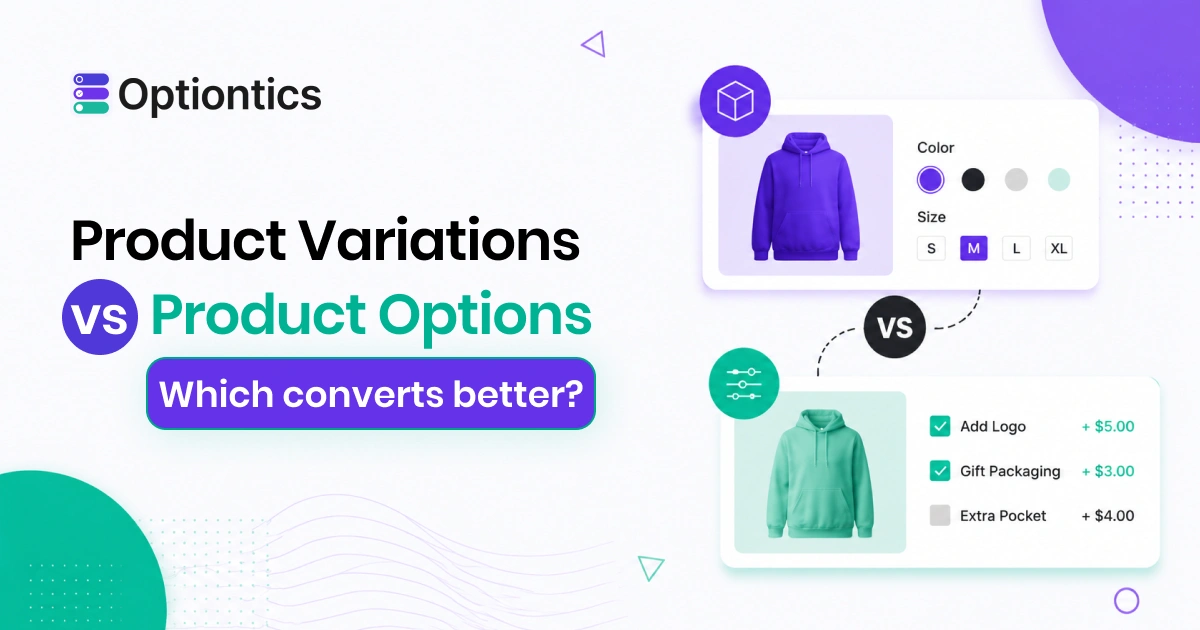
Table of Contents
Many WooCommerce store owners believe that offering more choices leads to more sales. But when product pages become filled with too many variations, options, and customization fields, customers can struggle to make a decision. More complexity often creates more hesitation, and hesitation can hurt conversions.
This raises an important question: Should you use product variations or product options?
The answer isn’t about choosing one over the other. Product variations and product options serve different purposes, and using the right approach can improve conversions, simplify product management, and create a better WooCommerce buying experience.
- Use product variations for inventory-controlled choices like size, color, and material.
- Use product options for personalization like engraving, file uploads, gift wrap, and add-ons.
- The highest-converting WooCommerce stores use both to reduce purchase friction and simplify product management.
- Optiontics combines variations and product options in one hybrid workflow, making customizable products easier to manage and scale.
Product Variations vs Product Options: What’s the Difference?
In simple terms, product variations help merchants manage inventory, while product options help customers personalize their purchases.
Many stores accidentally use variations for every customer choice, even when inventory tracking isn’t required. Over time, this creates unnecessary complexity for both shoppers and store owners.
What Are WooCommerce Product Variations?
WooCommerce product variations are predefined versions of the same product that usually require separate inventory tracking in WordPress. Each variation represents a real, stock-based difference that can have its own SKU, price, image, and inventory quantity.
Common examples include:
- Size (S, M, L)
- Color (Black, Blue, White)
- Storage (128GB, 256GB)
- Material (Wood, Metal)
For example, a clothing store may sell one T-shirt with three sizes and four colors. WooCommerce treats each combination as a separate variation because stock levels may differ.
What Are WooCommerce Product Options?
WooCommerce product options are additional choices customers can make that do not necessarily require separate inventory management in WordPress. Instead of creating new SKUs, options allow shoppers to personalize or enhance a product.
Examples include:
- Custom engraving
- Gift wrapping
- File uploads
- Warranty extensions
- Rush production
- Personalized messages
For example, a mug store doesn’t need a separate inventory item for every custom name a customer enters. A text field is often a more efficient solution.
Product Variations vs Product Options (Quick Comparison Table)
Although both help customers make a purchase decision, they serve very different business purposes. The table below shows where each approach fits.
| Feature | Product Variations | Product Options |
| Inventory tracking | Yes | Usually no |
| Separate SKUs | Yes | No |
| Product personalization | Limited | Extensive |
| File uploads | No | Yes |
| Gift wrap and add-ons | Limited | Yes |
| Dynamic pricing | Basic | Flexible |
| Best for | Physical product differences | Customer customization |
Which Converts Better: Product Variations or Product Options?
Product variations convert better for inventory-based choices like size, color, and storage, while product options convert better for personalization, add-ons, and custom requests.
The highest-converting stores use both, depending on the type of decision customers need to make. In fact, improving product customization and reducing purchase friction are important parts of WooCommerce conversion optimization and can significantly increase WooCommerce sales.
When Variations Convert Better
Variations perform best when customers are comparing standard versions of the same product. Choosing a T-shirt size, selecting a phone’s storage capacity, or picking a furniture finish are familiar decisions that shoppers understand immediately.
Because each choice may affect inventory, pricing, or the physical product itself, variations create a straightforward buying experience. Customers simply compare versions of the same product and choose the one that fits their needs.
When Options Convert Better
Product options become more effective when customers need to shape the product around their own requirements.
A customer ordering a personalized gift, a print-on-demand product, or a custom cake usually isn’t looking for another product variant. They want to add a message, upload an image, select an extra service, or customize the purchase.
For a practical example, see how to sell personalized gifts with WooCommerce using variations for mug sizes and product options for customer photos, names, and gift messages.
In these situations, flexibility matters more than predefined combinations, which is why product options often create a smoother buying experience.
But choosing the right approach is only half the challenge. Even the right system can reduce conversions when customers are presented with too many decisions or poorly organized choices.
Product Variations and Product Options: Common Mistakes That Hurt Conversions
Too many variations can make products difficult to choose. Too many options can make products difficult to configure.
The goal isn’t to reduce customer choice. It’s to present choices in a way that feels simple, intuitive, and easy to navigate.
When Too Many Product Variations Become a Problem
Product variations become a problem when they introduce more decisions than customers expect to make.
Imagine buying a T-shirt online. You expect to choose a size and a color. Instead, you’re presented with 10 sizes, 20 colors, 5 fabric types, 4 fits, 3 sleeve lengths, and multiple collar styles. Before you can add the product to your cart, you’re faced with hundreds of possible combinations.
The purchase starts to feel less like shopping and more like completing a form.
This is where choice overload begins to hurt conversions.
Every additional decision requires attention and mental energy. Even interested shoppers may postpone the purchase, compare alternatives, or leave the page entirely.
The problem becomes even more noticeable on mobile devices. Long variation selectors and large numbers of combinations can quickly make product pages feel overwhelming.
Too many variations can also create operational challenges. As the number of variation combinations grows, pricing, inventory updates, product images, and catalog maintenance become more difficult to manage.
Large variation sets may also affect page loading and backend performance, making WooCommerce performance optimization increasingly important as product catalogs grow.
The highest-converting product pages are rarely the ones with the most choices. They are the ones that make choosing feel effortless.
When Product Options Become a Problem
Product options can create similar issues when they’re poorly organized or presented all at once.
Imagine shopping for a personalized mug. You simply want to add a name as a gift. Instead, you’re asked to choose a font style, text color, engraving position, image upload, gift wrapping, premium packaging, gift note, matching accessories, and an extended warranty before you can add the product to your cart.
At this point, personalization starts to feel like work.
The problem isn’t offering customization. It’s asking customers to make too many decisions at the same time.
Every additional option increases cognitive load. When customers have to work through too many customization fields, they may abandon the purchase before completing it, especially on mobile devices.
Well-designed product options reveal additional choices only when they become relevant.
For example, font styles may only appear after engraving is selected. A gift message field may only appear after gift wrapping is chosen. Progressive disclosure keeps the interface clean while allowing customers to personalize products without feeling overwhelmed.
In other words, customers should customize products—not struggle to configure them.
The way you structure products doesn’t only affect conversions. It also influences how search engines and AI answer engines understand, organize, and surface your products.
How Product Structure Affects SEO
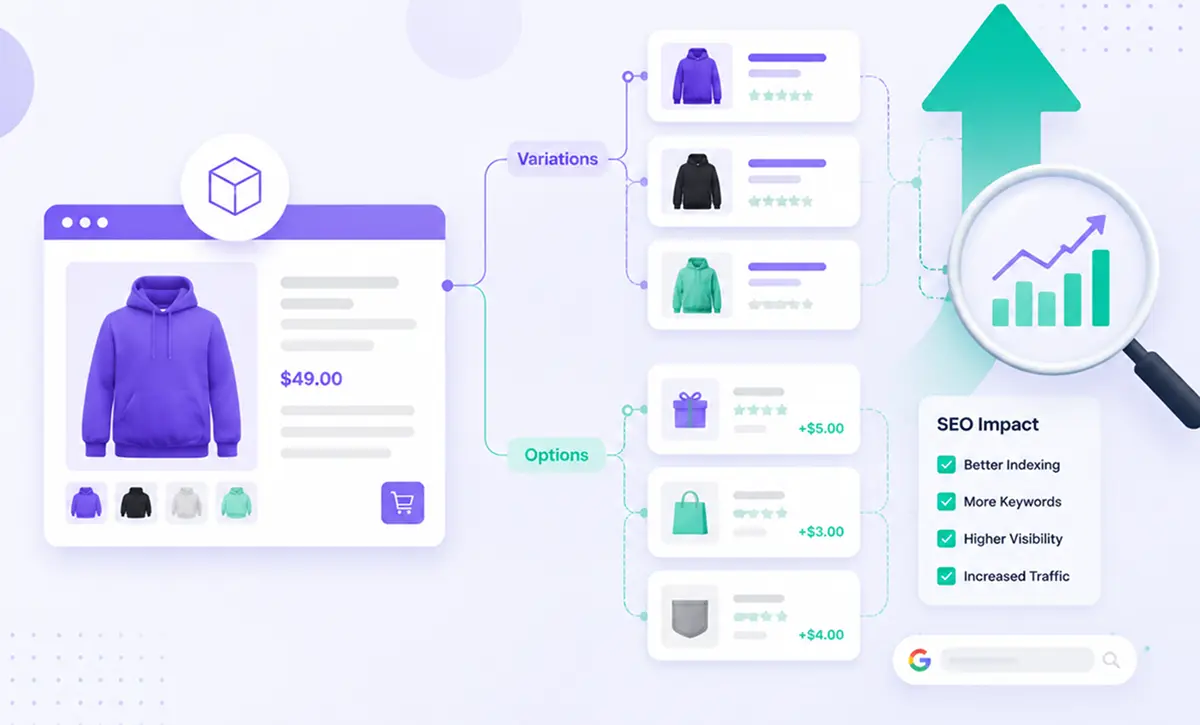
Product structure affects SEO because it influences how search engines understand your products, distribute authority across your catalog, and determine which pages deserve visibility.
From an SEO perspective, success rarely comes from creating more product pages. It comes from making your most important pages more useful, relevant, and authoritative.
Do Product Variations Create Duplicate Content?
Not necessarily. Native WooCommerce variations usually exist under a single product URL, so they do not automatically create duplicate content issues.
The bigger risk appears when merchants create separate pages for minor differences, such as individual pages for every color, material, or small customization.
Over time, this can create:
- Thin pages with nearly identical content
- Multiple URLs targeting the same keywords
- Keyword cannibalization
- Diluted internal authority
- More pages to maintain and optimize
The problem is not product variations themselves. The problem is creating more pages than search engines or customers actually need.
A simple rule is:
If customers see the products as essentially the same item, they often belong on the same page.
How Product Options Affect SEO
Product options often take the opposite approach. Instead of spreading information across many similar URLs, they allow different choices and personalization features to live on a single product page.
For example, a custom mug can offer engraving, gift wrapping, file uploads, and premium packaging without creating separate pages for every possible combination.
This approach helps consolidate relevance, backlinks, and internal authority into one page instead of splitting signals across multiple near-identical URLs.
In many cases, one comprehensive product page is more useful to both customers and search engines than several smaller pages competing against each other.
Search Visibility Considerations
Search engines increasingly reward pages that satisfy multiple user needs.
A well-structured product page can often address:
- Different sizes and colors
- Personalization options
- Add-on services
- Customization requirements
- Frequently asked questions
without forcing customers to visit multiple pages.
As a result, a single strong product page often performs better than dozens of low-value pages competing with each other.
This approach can also improve visibility in AI-powered search experiences because a single, comprehensive product page provides search engines and answer engines with more context about the product, its customization options, and the problems it solves.
Following established WooCommerce SEO best practices can further help search engines understand product relationships and surface the right pages for relevant searches
A simple principle many e-commerce teams follow is this: Build stronger pages, not simply more pages.
Good product structure isn’t only about rankings. It’s also about creating pages that are easier to understand, easier to discover, and more useful for customers.
As product catalogs grow, maintaining this balance between flexibility and simplicity becomes increasingly difficult. This is where many WooCommerce stores start running into scalability problems.
Why Product Customization Becomes Difficult to Scale
As WooCommerce stores grow, product customization often becomes difficult because product variations start handling decisions they were never designed to manage. Many store owners eventually turn to WooCommerce product add-ons to offer personalization features without creating hundreds of variation combinations.
Many stores also rely on WooCommerce Product add-ons and dynamic pricing to offer advanced customization without creating hundreds of product variations.
When Variations Start Carrying Too Much Responsibility
Imagine a custom T-shirt store.
Size and color belong in the variation system because they affect inventory. But customers may also want to upload a logo, add a custom name, choose gift packaging, or request rush production.
None of these choices requires separate inventory tracking.
Yet many stores still create variations for them.
Over time, a simple product can turn into dozens or even hundreds of combinations. Product updates become slower, pricing becomes harder to manage, and adding new customization features requires even more administration.
The challenge isn’t creating variations. It’s maintaining them as products and customization requirements grow.
Eventually, managing product configurations starts taking time away from growing the business.
Why Many Stores Separate Inventory and Personalization
To solve this problem, many WooCommerce stores now separate two different responsibilities:
- Inventory decisions
- Customer personalization
Consider a furniture store.
The size and material of a table affect manufacturing and stock, so they remain product variations.
But engraving, assembly service, and premium delivery are simply customer preferences. They don’t need separate inventory records.
Treating these choices as product options keeps the product structure much simpler.
This approach gives customers more flexibility while keeping product management manageable.
The Hybrid Model Used by High-Converting Stores
Most successful WooCommerce stores do not choose between product variations and product options. They use both.
A simple rule is: Variations manage inventory. Product options manage customization.
If a choice changes stock, pricing, or the physical product itself, it usually belongs in the variation system.
If a choice personalizes the purchase or adds an extra service, it usually works better as a product option.
This hybrid model creates three important benefits:
- Easier product management
- Better customer experience
- More scalable product catalogs
Understanding the strategy is one thing. Implementing it efficiently inside WooCommerce is another.
Bringing the Hybrid Model to WooCommerce with Optiontics
Many WooCommerce stores understand the idea of separating inventory decisions from customer customization. The challenge is implementing that separation in a way that remains easy to manage as the catalog grows.
This is where Optiontics helps.
Why Many WooCommerce Stores Struggle With Product Configuration
Native WooCommerce variations work exceptionally well for inventory management. Problems usually appear when stores start using them for personalization, file uploads, add-on services, conditional choices, and dynamic pricing.
As products become more customizable, product pages become harder to manage, and even simple updates can require unnecessary administrative work.
How Optiontics Solves the Problem
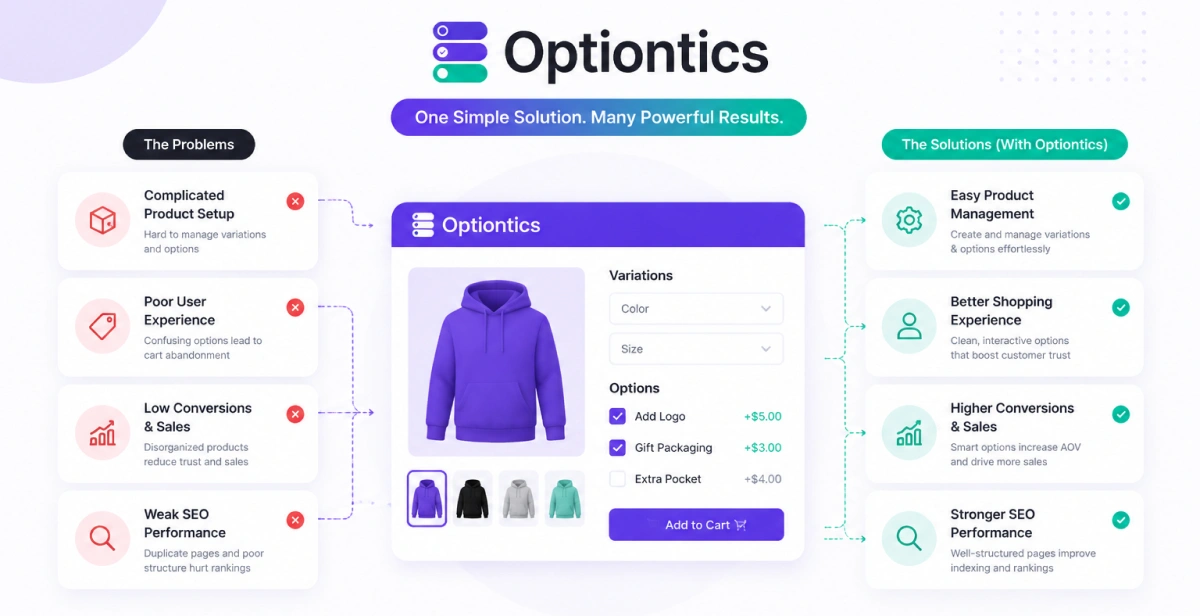
Optiontics helps WooCommerce stores separate inventory management from customer customization.
Instead of turning every customer preference into another product variation, stores can keep inventory-related decisions inside WooCommerce variations while handling personalization, file uploads, add-ons, and conditional choices through flexible product options.
For example, a custom apparel store can keep size and color as variations while collecting logo uploads, custom text, gift packaging, and rush production requests through product options.
The same approach works across many industries. An engraved jewelry store can track inventory by material while collecting engraving details as options.
A furniture store can manage stock by dimensions while offering assembly and delivery upgrades.
A bakery can sell one cake product while allowing customers to upload images, choose delivery dates, and add personalized messages.
Optiontics also supports advanced workflows that become difficult to manage with native variations alone, including conditional logic, file uploads, image and color swatches, formula pricing, reusable product templates, and dynamic pricing in WooCommerce.
These features make it easier for stores to offer highly customizable products without creating hundreds of variation combinations or an unmanageable product catalog.
The goal is simple: Use variations where inventory matters. Use product options where customization matters.
Ready to implement the hybrid model? Explore Optiontics features or compare pricing to find the plan that best fits your WooCommerce store.
Frequently Asked Questions
What is the difference between product variations and product options?
Product variations represent inventory-based differences, such as size or color. Product options allow customers to personalize a product without creating separate inventory records.
Which converts better: product variations or product options?
Neither is universally better. Variations work best for stock-based decisions, while product options work better for personalization and add-on purchases.
When should I use product variations instead of product options?
Use variations when a choice changes inventory, pricing, or the physical product itself.
Can product options replace product variations?
No. Product options complement variations rather than replace them. Most successful stores use both together.
Are product options better for personalized products?
Yes. Product options are often a better fit for custom text, file uploads, gift messages, and other personalization features that do not require inventory tracking.
Can WooCommerce stores use variations and product options together?
Absolutely. Many high-performing WooCommerce stores use variations for inventory management and product options for customization.
What types of businesses benefit most from product options?
Personalized gifts, print-on-demand stores, custom apparel businesses, furniture stores, and products with service add-ons often benefit the most.
Final Verdict
The question isn’t whether product variations or product options convert better. The real question is whether your product pages make buying easy.
Variations work best for inventory-driven decisions, while product options are better for personalization and add-ons. The highest-converting WooCommerce stores use both together to create simpler buying experiences and easier product management.
If your product catalog is becoming difficult to scale, Optiontics can help you combine variations and product options without adding unnecessary complexity.